Indoor air quality plays an important role in maintaining a healthy, productive, and comfortable office environment. In Sydney workplaces, allergens such as dust, pollen, mould spores, pet dander, and fine airborne particles can accumulate throughout the day, affecting employee comfort and contributing to allergy symptoms. While regular surface cleaning removes visible dirt and contaminants, many allergens remain in the air or become recirculated during routine cleaning if the right equipment is not used.
This is where High-Efficiency Particulate Air (HEPA) filters make a measurable difference. HEPA filters improve indoor air quality in commercial buildings. However, creating a healthier workplace involves more than installing high-performance filters. Businesses also need a structured cleaning program that removes contaminants from floors, furniture, workstations, and other surfaces where allergens naturally accumulate.
In this guide, you’ll learn how HEPA filters reduce allergens in Sydney offices, the types of airborne particles they capture, why professional commercial cleaning remains essential, and how a comprehensive cleaning program can help businesses improve indoor air quality and support employee wellbeing.
What Is a HEPA Filter?
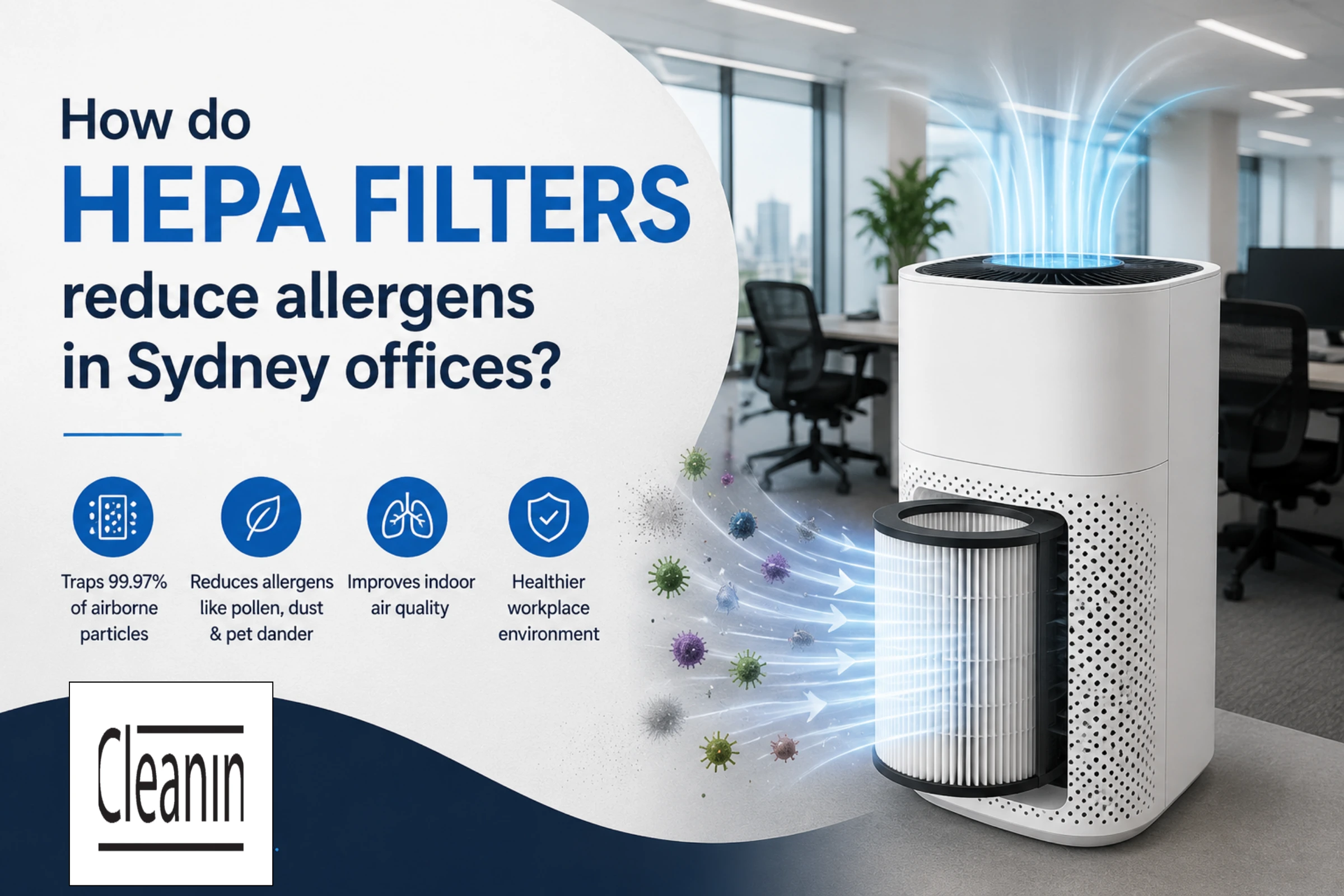
A High-Efficiency Particulate Air (HEPA) filter is a specialised air filter designed to capture extremely small airborne particles before they are recirculated into the indoor environment. HEPA filters are composed of a mat of randomly arranged fibers. The fibers are typically composed of polypropylene or fiberglass with diameters between 0.5 and 2.0 micrometers.
Unlike conventional air filters, HEPA filters are manufactured to meet strict filtration efficiency standards. A true HEPA filter must remove at least 99.97% of airborne particles measuring 0.3 microns (μm) under the U.S. standard, while the ISO and European standards require a minimum efficiency of 99.95% at the same particle size. Because 0.3 microns is the Most Penetrating Particle Size (MPPS), it is considered the most difficult particle size to capture. HEPA filters are even more efficient at trapping particles that are larger and smaller than this size.
Originally developed for applications requiring high levels of air purity, HEPA filters are now widely used in commercial buildings, healthcare facilities, air purifiers, HVAC systems, and professional cleaning equipment to improve indoor air quality.
Professional commercial cleaning services often use HEPA-filtered vacuum cleaners because they not only remove dust and debris from floors and carpets but also prevent many microscopic particles from being released back into the air during the cleaning process. When combined with routine office cleaning, HEPA filtration helps create a cleaner and healthier workplace.
What are the Common Allergens Found in Sydney Offices?
Office buildings may appear clean, but microscopic allergens can accumulate in the air and on workplace surfaces throughout the day. Employees, visitors, ventilation systems, open windows, and daily business activities continually bring airborne particles into the workplace. Over time, these allergens can affect indoor air quality and contribute to allergy symptoms, particularly in offices with carpets, upholstered furniture, or high occupant density.
Some of the common allergens that are found in Sydney offices are:
Dust Mites
Dust mites are microscopic arachnids that thrive in warm, humid environments where dust accumulates. Although they are invisible to the naked eye, their waste particles and body fragments are common indoor allergens that can trigger allergic reactions and asthma symptoms.
In office environments, dust mites are often found in carpets, upholstered chairs, fabric partitions, curtains, and other soft furnishings where dust collects over time. While HEPA filters can capture airborne dust mite allergens, regular vacuuming with HEPA-filtered vacuum cleaners and scheduled carpet cleaning are essential for removing dust that settles on workplace surfaces.
Pollen
Pollen is one of the most common seasonal allergens affecting Sydney workplaces. Grass, tree, and weed pollen can enter office buildings through open windows, ventilation systems, clothing, and footwear. During peak pollen seasons, these particles may accumulate indoors even when windows remain closed.
Once inside the workplace, pollen settles on desks, carpets, furniture, and other surfaces before becoming airborne again through employee movement or routine activities. HEPA filtration helps capture airborne pollen, while professional commercial cleaning removes pollen that has settled throughout the office, supporting better indoor air quality.
Mould Spores
Mould spores are naturally present in the air but can become a concern when excess moisture allows mould to grow indoors. Water leaks, condensation, poor ventilation, or high humidity can create conditions that encourage mould growth in commercial buildings.
Airborne mould spores may contribute to respiratory irritation and allergy symptoms in susceptible individuals. Routine cleaning, moisture management, and prompt attention to water damage help minimise mould growth, while HEPA-filtered equipment assists in capturing airborne mould spores during cleaning.
Pet Dander
Even in pet-free workplaces, pet allergens are commonly found in offices. Pet dander consists of tiny flakes of skin shed by animals and is often carried into the workplace on employees’ clothing, shoes, bags, and personal belongings.
Because pet dander particles are lightweight, they can remain suspended in the air for extended periods before settling onto office furniture, carpets, and workstations. HEPA filtration helps reduce airborne pet dander, while routine surface cleaning removes particles that have accumulated throughout the workplace.
Fine Dust and Airborne Particles
Fine dust and airborne particulate matter are generated both indoors and outdoors. Common sources include paper fibres, textile fibres, skin flakes, construction dust, vehicle emissions entering through ventilation systems, and general workplace activities. Sydney offices may also experience elevated levels of fine particulate matter during bushfire smoke events or periods of poor outdoor air quality.
These microscopic particles can remain suspended in the air for extended periods and are easily redistributed during cleaning if standard vacuum cleaners without effective filtration are used. According to the U.S. Environmental Protection Agency (EPA), true HEPA filters capture at least 99.97% of airborne particles measuring 0.3 microns, helping reduce the concentration of fine airborne particles that contribute to poor indoor air quality.
Because many allergens eventually settle onto floors, carpets, furniture, and other workplace surfaces, businesses achieve the best results by combining HEPA-filtered equipment with a professional commercial cleaning service. This integrated approach removes allergens from both the air and the workplace, helping create a cleaner and healthier office environment.
How HEPA Filters Reduce Allergens in Sydney Offices?
HEPA filters improve indoor air quality by continuously removing airborne particles that contribute to allergies and respiratory irritation. Rather than allowing these particles to circulate throughout an office, HEPA filtration captures them before they can settle on surfaces or be inhaled by building occupants.
For Sydney businesses, this means cleaner indoor air, fewer airborne contaminants, and a healthier workplace when HEPA filtration is combined with a structured commercial cleaning program.
The following explains the key ways HEPA filters help reduce allergens in office environments:
- Capturing Microscopic Airborne Particles
- Preventing Allergens from Re-entering the Air
- Supporting Healthier Indoor Air Quality
- Reducing Allergen Build-Up During Cleaning
1. Capturing Microscopic Airborne Particles
One of the primary functions of a HEPA filter is to remove microscopic airborne particles that are difficult to capture with conventional air filters. As air moves through the filter, a dense network of fine fibres traps particles through interception, impaction, and diffusion before they can continue circulating indoors.
A true HEPA filter is certified to remove at least 99.97% of airborne particles measuring 0.3 microns, while achieving even greater efficiency for many particles that are larger or smaller than this size. This high level of filtration helps reduce the concentration of airborne dust, pollen, mould spores, pet dander, and other fine particulate matter that can affect indoor air quality.
In busy office environments where employees, visitors, and ventilation systems constantly introduce new airborne particles, continuous filtration helps maintain cleaner air throughout the working day.
2. Preventing Allergens from Re-entering the Air
Removing airborne particles is only part of effective allergen control. During cleaning, conventional vacuum cleaners without high-efficiency filtration can release fine dust and allergens back into the office through the vacuum exhaust. This process, often called re-aerosolisation, reduces cleaning effectiveness by redistributing particles that were intended to be removed.
HEPA-filtered vacuum cleaners are designed to retain these microscopic particles within the filtration system instead of allowing them to escape back into the workplace. This means allergens collected during vacuuming remain trapped inside the equipment, reducing the likelihood of airborne particles being redistributed while cleaning is underway.
For workplaces with carpeted floors, fabric seating, and high daily occupancy, preventing re-aerosolisation contributes to a more effective cleaning process and better indoor hygiene.
3. Supporting Healthier Indoor Air Quality
Cleaner indoor air benefits both the workplace environment and the people who use it every day. By reducing the concentration of airborne allergens, HEPA filtration can help minimise exposure to particles that commonly trigger allergy symptoms and respiratory irritation.
Research has shown that portable HEPA air cleaners can significantly reduce airborne particulate matter when used appropriately, supporting healthier indoor environments. However, their effectiveness depends on factors such as room size, airflow, ventilation, and regular filter maintenance.
For Sydney offices, HEPA filtration works best as part of a broader indoor air quality strategy that includes routine commercial cleaning, effective ventilation, and ongoing building maintenance. Together, these measures help create a cleaner and more comfortable workplace for employees and visitors.
4. Reducing Allergen Build-Up During Cleaning
Professional commercial cleaning does more than improve the appearance of an office. When HEPA-filtered equipment is incorporated into routine cleaning, it helps minimise the accumulation and redistribution of allergens over time.
Vacuuming carpets, cleaning upholstered furniture, and removing dust from workstations with HEPA-filtered equipment reduces the amount of fine particulate matter left behind after cleaning. This is particularly beneficial in offices with heavy foot traffic or large carpeted areas, where allergens can accumulate between scheduled cleaning visits.
By combining HEPA filtration with systematic cleaning procedures, businesses can maintain lower allergen levels throughout the workplace instead of simply moving dust and fine particles from one area to another. This integrated approach supports cleaner indoor environments and reinforces the value of partnering with a professional commercial cleaning service that uses HEPA-filtered equipment as part of its cleaning program.
Why HEPA Filters Alone Are Not Enough for Sydney Offices?
HEPA filters are highly effective at capturing airborne particles, but they cannot remove every source of allergens within an office. Many allergens eventually settle onto workplace surfaces where they remain until they are physically removed through cleaning. Without regular cleaning, these contaminants can accumulate over time and become airborne again as employees move through the workplace.
For businesses aiming to improve indoor air quality, the most effective approach combines HEPA filtration with a professional commercial cleaning service. Together, they address both airborne allergens and contaminants that settle throughout the office environment.
The reasons why HEPA filters alone are not enough for Sydney offices are:
Allergens Also Settle on Surfaces
Not all allergens remain in the air. As dust, pollen, mould spores, and other microscopic particles circulate through an office, they gradually settle onto desks, shelving, windowsills, electronic equipment, light fittings, and other workplace surfaces.
Daily activities such as walking through the office, opening doors, operating air conditioning systems, or moving furniture can disturb these settled particles, allowing them to become airborne again. This continuous cycle means that air filtration alone cannot permanently remove allergens from the workplace.
Routine dusting and surface cleaning interrupt this cycle by physically removing settled allergens before they can be redistributed into the indoor environment.
Carpets and Upholstery Trap Allergens
Soft furnishings are among the largest reservoirs of allergens in many office environments. Carpets, fabric office chairs, partitions, and upholstered furniture can trap dust, pollen, pet dander, and other fine particles deep within their fibres, where they accumulate between cleaning cycles.
Although HEPA-filtered vacuum cleaners are highly effective at capturing loosened airborne particles during vacuuming, they do not eliminate the need for routine carpet maintenance. Regular vacuuming, periodic deep carpet cleaning, and upholstery cleaning help remove embedded contaminants that standard surface cleaning cannot reach.
For offices with extensive carpeting or high employee occupancy, maintaining these areas is an important part of reducing long-term allergen build-up and supporting healthier indoor environments.
Air Filtration Cannot Replace Professional Cleaning
HEPA filtration and commercial cleaning perform different but complementary functions. Air filtration continuously removes airborne particles as air passes through the filter, while professional cleaning removes contaminants that have settled onto workplace surfaces and within building materials.
An effective office hygiene program therefore combines both approaches. HEPA-filtered equipment helps reduce airborne allergens during the cleaning process, while professional cleaning removes dust, debris, and biological contaminants from floors, carpets, workstations, shared amenities, and other frequently used areas.
The U.S. Environmental Protection Agency (EPA) also advises that air cleaners and HEPA filtration should be used alongside routine cleaning and proper ventilation rather than as a replacement for them. By integrating these measures into a scheduled commercial cleaning program, Sydney businesses can achieve more comprehensive allergen control, improve indoor air quality, and maintain a cleaner, healthier workplace throughout the year.
How to Improve Indoor Air Quality Beyond HEPA Filters?
HEPA filters play an important role in reducing airborne allergens, but maintaining healthy indoor air quality requires a broader approach. Air quality is influenced by multiple factors, including cleaning practices, ventilation, moisture levels, building maintenance, and how contaminants are managed throughout the workplace.
By combining routine cleaning with preventative maintenance and effective building management, Sydney businesses can create healthier office environments that support employee wellbeing and reduce the accumulation of indoor pollutants.
Follow these procedures to Improve Indoor Air Quality Beyond HEPA Filters:
Routine Commercial Cleaning
Routine commercial cleaning removes dust, allergens, and other contaminants before they build up throughout the workplace. Regular cleaning of workstations, shared amenities, floors, and high-touch surfaces reduces the amount of particulate matter that can become airborne during daily activities.
A scheduled cleaning program also helps maintain consistent hygiene standards and allows businesses to address different areas according to their level of use and exposure to contaminants.
HVAC Maintenance
Heating, ventilation, and air conditioning (HVAC) systems play a significant role in circulating indoor air. If air filters become clogged or ventilation components are poorly maintained, dust and other airborne particles may continue to circulate throughout the building.
Routine inspection, filter replacement, and preventive maintenance help HVAC systems operate efficiently while supporting cleaner indoor air. Businesses should also ensure ventilation systems are serviced according to the manufacturer’s recommendations.
Air Purifier Maintenance
Air purifiers fitted with HEPA filters require regular maintenance to continue operating effectively. As filters capture airborne particles, they gradually become loaded with contaminants, reducing airflow and filtration performance.
Replacing filters at the intervals recommended by the manufacturer and maintaining the unit according to its operating requirements helps ensure consistent air filtration and supports better indoor air quality over time.
Humidity Control
Indoor humidity influences the growth of biological contaminants such as mould and dust mites. Excess moisture can encourage mould development, while very dry conditions may increase airborne dust and cause discomfort for building occupants.
Maintaining indoor humidity within an appropriate range helps reduce conditions that allow allergens to multiply and contribute to a more comfortable office environment. Addressing water leaks, condensation, and moisture problems promptly is also essential for preventing mould growth.
Ventilation
Fresh air ventilation helps dilute indoor pollutants by introducing outdoor air and reducing the concentration of airborne contaminants inside the workplace. Well-designed ventilation systems also improve air circulation, helping maintain a healthier indoor environment.
Businesses should ensure ventilation systems remain unobstructed and operate as intended. Where practical, increasing fresh air intake alongside routine maintenance can further support indoor air quality.
Carpet Cleaning
Carpets collect dust, soil, pollen, and other fine particles that gradually accumulate within the carpet fibres. While routine vacuuming removes surface debris, periodic professional carpet cleaning helps extract embedded contaminants that cannot be removed through regular maintenance alone.
Scheduling carpet cleaning at appropriate intervals supports cleaner indoor environments and helps extend the lifespan of commercial flooring.
Upholstery Cleaning
Office chairs, sofas, meeting room seating, and fabric partitions also collect dust and airborne particles over time. Without regular maintenance, these materials can become ongoing sources of indoor allergens.
Professional upholstery cleaning removes accumulated contaminants while helping preserve the appearance and condition of office furnishings. Including upholstery in a scheduled cleaning program contributes to a more comprehensive approach to workplace hygiene.
Waste Management
Waste bins, food waste, and recyclable materials can affect indoor air quality if they are not managed consistently. Overflowing bins may contribute to unpleasant odours, attract pests, and increase bacterial growth within shared office areas.
Establishing a routine waste management process, including regular bin emptying, cleaning waste receptacles, and separating recyclable materials, helps maintain a cleaner workplace and reduces unnecessary sources of indoor contamination.
By integrating these measures into a proactive workplace maintenance strategy, businesses can achieve better long-term indoor air quality than relying on HEPA filtration alone. Professional commercial cleaning services support this approach by combining routine cleaning, specialist floor and upholstery care, and industry best practices to help create healthier office environments across Sydney.