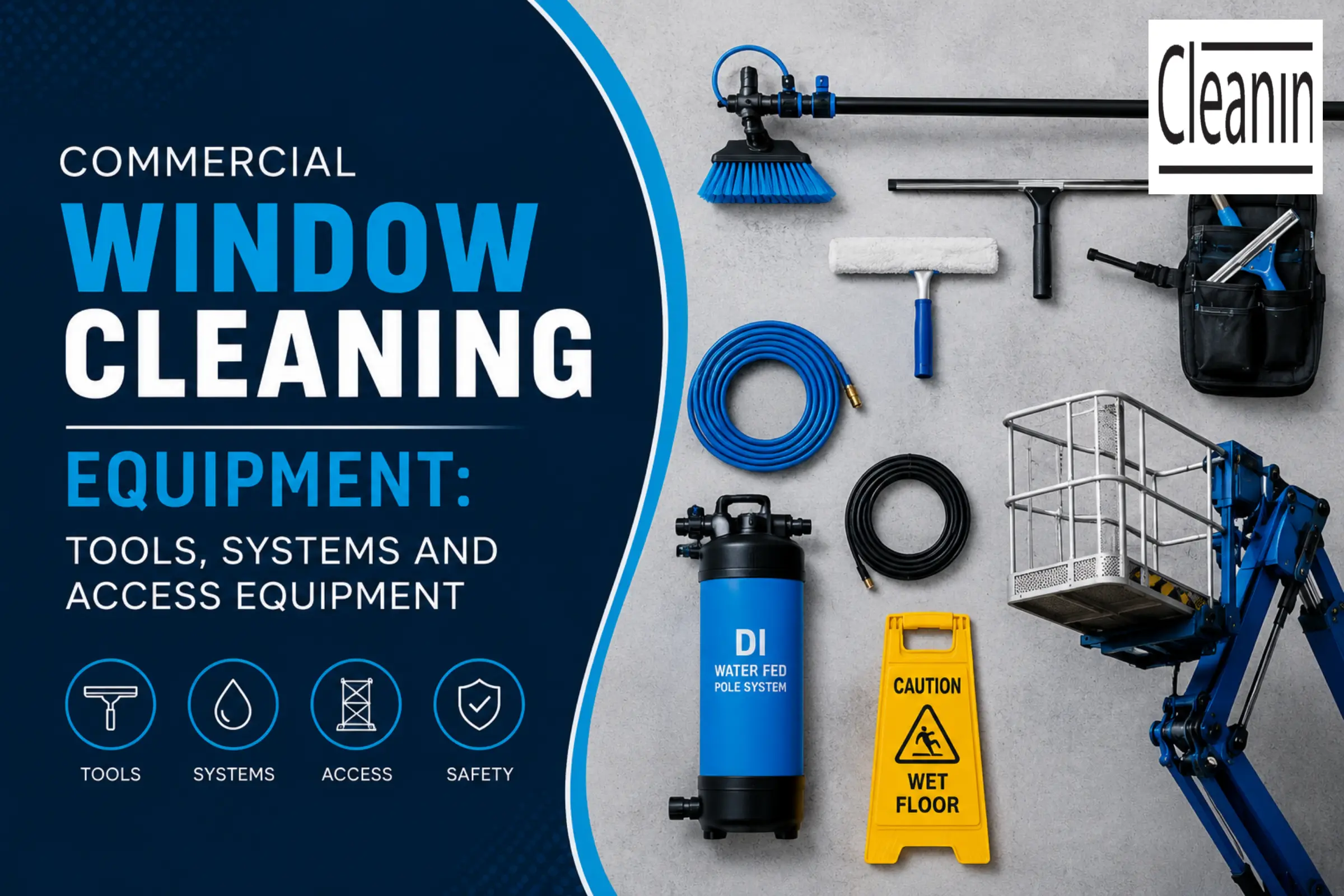
Large glass panels, high-rise facades, hard-to-reach windows, stubborn dirt and frequent foot traffic all affect how quickly commercial glass becomes marked or dirty. The right equipment allows cleaning teams to manage these conditions efficiently and achieve a clear, streak-free finish.
From traditional squeegees, window washers and microfibre cloths to water-fed poles, pure water systems and rope access equipment, commercial window cleaning draws on different tools for different buildings and surfaces. A ground-floor shopfront may need only a squeegee, applicator and bucket, while a multi-storey commercial property needs a water-fed pole, pure water system or access equipment as well.
Understanding this equipment helps business owners and facility managers assess what a window cleaning service should provide, compare service capabilities and determine the right cleaning approach for their property.
What Equipment Is Used for Commercial Window Cleaning?
Commercial window cleaning equipment falls into six categories: traditional glass-cleaning tools, water-fed pole systems, pure water equipment, access equipment, rope access equipment and safety equipment. Each category serves a distinct function, from removing dirt to enabling safe work at height.
Some tools remove dirt from the glass. Others apply water, dry the surface, remove residue or provide access to windows at height. The building determines the combination, not the equipment list on its own.
Some of the equipment used for commercial window cleaning is:
- Squeegee
- Window Washer or Applicator
- Scrubber
- Microfibre Cloth
- Scrim
- Chamois
- Window Cleaning Bucket
- Window Scraper
- Glass Cleaning Solution
- Extension Pole
- Water-fed pole
- Pure Water Equipment
1. Squeegee
A squeegee removes water and cleaning solution from glass using a rubber blade held in a channel and handle.
Blade length varies with window size. A shorter blade gives better control around small panes. A wider channel covers larger areas more efficiently. Blade condition affects the result: a worn or damaged blade leaves water behind and contributes to streaking.
2. Window Washer or Applicator
An applicator applies water and cleaning solution to the glass, typically using a T-bar with a removable sleeve.
Microfibre and other sleeve materials spread the solution and agitate dirt across the surface. The applicator prepares the glass before the squeegee removes loosened dirt and moisture.
3. Scrubber
A window scrubber loosens dirt before the glass is dried.
Sleeve material determines how the scrubber interacts with the surface. Some sleeves suit general cleaning, while others provide greater agitation for heavier dirt. Windows exposed to traffic, dust and environmental contamination generally need this scrubbing step before drying.
4. Microfibre Cloth
A microfibre cloth handles detailing rather than removing water from an entire pane.
Its absorbency and low-lint properties suit frames, edges, corners and small areas a squeegee cannot reach effectively. Cleaning teams typically use microfibre cloths after the main glass-cleaning process to finish edges and surrounding surfaces.
5. Scrim
A scrim is a lightweight cloth used for drying and polishing glass.
It removes remaining moisture and reduces streaks during final detailing, particularly around edges and areas needing additional finishing.
6. Chamois
A chamois absorbs water and finishes glass surfaces.
Its primary function is moisture absorption. Chamois remains part of the traditional equipment category, though many commercial cleaners now use microfibre products alongside it.
7. Window Cleaning Bucket
A window cleaning bucket stores water and cleaning solution and holds an applicator or scrubber during use.
Capacity matters more across large commercial areas. Bucket size should match the cleaning method and area being covered.
8. Window Scraper
A window scraper removes material that washing alone cannot clear, such as paint, adhesive and stickers, from compatible glass surfaces.
The blade requires careful use. Incorrect scraping technique, or scraping without assessing debris and surface condition first, can damage glass or leave scratches.
9. Glass Cleaning Solution
A glass cleaning solution contains water, detergent, or surfactants that loosen dirt and grease.
Concentration and formulation should match the surface and task. Excess solution leaves residue. An unsuitable product can affect certain finishes. The goal is loosening contamination without adding residue that makes the glass harder to finish.
10. Extension Pole
An extension pole increases reach from ground level or another safe working position.
Telescopic poles adjust to different lengths and come in materials that balance reach, weight and rigidity. An extension pole reduces the need to reposition access equipment repeatedly for suitable low- and mid-level windows.
11. Water-Fed Pole Equipment
A water-fed pole system cleans exterior glass from ground level using a telescopic pole, brush head, water jets and a hose connected to a purified water supply.
i. Water-Fed Pole
A water-fed pole is the telescopic pole component that carries water from the hose to the brush head at height.
Pole length, material and weight determine reach and handling. Carbon-fibre poles balance low weight with rigidity, which matters more as reach increases. Fibreglass poles offer a lower-cost alternative where maximum reach is less critical. Pole selection depends on the required reach, weight and working conditions.
ii. Water-Fed Brush
The water-fed brush sits at the end of the pole and performs the cleaning action. Its bristles agitate dirt on the glass while water jets built into the brush head deliver purified water to the surface.
Brush width, weight and bristle characteristics affect performance across different cleaning conditions. Softer bristles suit delicate surfaces. More aggressive bristles provide greater agitation for heavier contamination. Glass condition and cleaning requirements determine the correct brush.
iii. Water Jets and Hose System
Water jets sit within the brush head and release purified water onto the glass as the brush agitates dirt from the surface.
The hose carries purified water from the tank and pump, through the pole, to the water jets. A hose reel manages hose length during operation and storage, reducing tangling and wear across repeated use. Hose length and diameter affect water flow and the system’s practical working reach from the water source.
12. Pure-Water Equipment
Pure-water equipment purifies the water supplying a water-fed pole system, removing dissolved minerals before the water reaches the glass. Pure water window cleaning commonly targets 0 ppm total dissolved solids, since dissolved minerals cause spotting as water dries.
i. Reverse Osmosis System
A reverse osmosis system uses a membrane to reduce dissolved contaminants in the water supply.
Reverse osmosis typically forms the initial purification stage, reducing the mineral load before the water reaches further filtration stages.
ii. Deionisation System
A deionisation system uses ion-exchange resin to remove charged minerals remaining in the water after reverse osmosis.
Deionisation usually follows reverse osmosis in the purification sequence, producing water suitable for water-fed window cleaning.
iii. Carbon Filter
A carbon filter provides an earlier treatment stage within the purification system, removing chlorine, sediment and organic contaminants before the water reaches the reverse osmosis membrane.
Removing these contaminants earlier in the sequence protects the reverse osmosis membrane from premature fouling.
iv. TDS Meter
A TDS meter measures total dissolved solids in water and indicates the remaining mineral content after purification.
Lower TDS means fewer dissolved solids are available to form mineral deposits on glass as it dries. Monitoring TDS against the 0 ppm target helps confirm the purification system is producing water suitable for spot-free drying.
v. Water Tank and Pump
A water tank stores purified water for use during cleaning, while a water pump moves that water from the tank through the hose to the pole.
Tank capacity determines how much purified water is available before refilling or reconnecting to a purification system is required. Pump flow rate affects water delivery to the brush head, particularly at greater pole reach.
What Access Equipment is Used for Commercial Window Cleaning?
Building height, facade design, surrounding surfaces and window location determine which access method a property requires, ranging from ladders and extension poles at ground level to suspended platforms and rope access on high-rise facades.
Ladders and Extension Ladders
Ladders suit low-level work where site conditions allow their use, and apply more to smaller or lower building sections than large-scale facade cleaning.
Scaffolding and Scaffold Towers
Scaffolding creates a stable working platform for suitable building and construction environments. Setup requirements depend on the building, work area and access needs.
Scissor Lifts
A scissor lift is a mobile elevating work platform that gives vertical access to elevated areas. It suits sites with sufficient space and windows positioned above ground level.
Boom Lift or Cherry Picker
A boom lift, also called a cherry picker, gives elevated and lateral reach, useful when windows sit outside the machine’s direct vertical position.
Suspended Platforms
Suspended platforms give access to elevated facades on suitable buildings, particularly to larger commercial and high-rise properties with windows across multiple levels.
Building Maintenance Unit
A building maintenance unit (BMU) is a permanent facade-access system installed on some larger buildings, giving a dedicated method for accessing and maintaining external facades where fitted.
| Access equipment | Best suited for |
|---|---|
| Ladder | Low-level, short-duration work |
| Extension pole | Extended reach from ground level |
| Water-fed pole | Low-to-mid-level exterior glass |
| Scissor lift | Vertical access on suitable surfaces |
| Boom lift/cherry picker | Elevated or offset access |
| Suspended platform | High-rise facades |
| Building maintenance unit | Buildings with permanent facade access |
| Rope access | Complex or high-rise facades |
What Safety Equipment Is Used for Commercial Window Cleaning?
Commercial window cleaning safety equipment covers fall protection, PPE and site-control equipment, selected according to the cleaning method, access equipment and site conditions. Wet surfaces, elevated work, moving vehicles and pedestrian traffic near the work area are the main hazards this equipment addresses.
Fall Protection Equipment
Fall protection equipment includes a safety harness, anchor points and lanyards, and forms part of the safety system whenever elevated work is required.
The harness connects to an anchor point rated for the access method being used, with the lanyard limiting fall distance if the harness is loaded. Anchor point capacity and system configuration should match the access method and site assessment, not a generic fall-protection setup.
Helmets and Personal Protective Equipment
PPE for commercial window cleaning includes a helmet, gloves, eye protection and non-slip footwear.
Each item addresses a specific hazard: a helmet protects against impact during elevated or overhead work, gloves protect against chemical exposure and sharp residue during scraping, eye protection guards against splashback from cleaning solutions, and non-slip footwear reduces slip risk on wet surfaces. The combination required depends on the cleaning method, equipment and site conditions.
Equipment Inspection and Risk Assessment
Fall protection and access equipment require inspection before use to confirm harnesses, anchor points and lanyards are within their service condition.
Risk assessment identifies site-specific hazards, such as wet surfaces, vehicle movement or pedestrian traffic, before work begins, and determines which PPE and fall-protection combination the site requires.
Warning Signs, Cones and Barriers
Commercial window cleaning often takes place around employees, customers, vehicles and pedestrians. Warning signs, safety cones and barriers identify the work area and reduce pedestrian access while cleaning is underway.
Site-control equipment is selected based on foot traffic volume and the work area’s proximity to entrances, walkways or vehicle routes.
FAQ
Do all commercial buildings need a water-fed pole system?
No, commercial buildings with ground-level and low-rise windows within squeegee and extension pole reach do not require a water-fed system. I’d expect water-fed poles to become relevant once reach or window count increases beyond what traditional tools can cover efficiently.
Is rope access more expensive than a scissor lift or boom lift?
Cost depends on the site. I’d note that rope access typically applies where a lift cannot physically access the facade, so the comparison is usually about feasibility first and cost second.
Can water-fed poles clean windows above ground-floor level?
Yes, within the pole’s reach and the building’s access conditions. Multi-storey buildings often combine water-fed poles with a scissor lift or boom lift once reach exceeds pole capability.
What does a TDS reading actually indicate during window cleaning?
It indicates the concentration of dissolved minerals remaining in the water. I’d treat a reading close to 0 ppm as confirmation the purification system is producing water suited to spot-free drying.
Does a building need a BMU for professional window cleaning?
No, buildings don’t need a BMU for professional window cleaning. A BMU is a permanent facade-access system found on some larger buildings. Buildings without one still have windows cleaned using scissor lifts, boom lifts, suspended platforms or rope access, depending on the facade.
Get Commercial Window Cleaning for Your Property
Commercial window cleaning equipment only performs to the level it is matched to the building and glass condition. A cleaning provider should be able to assess a property’s access requirements and apply the appropriate combination, from squeegees and applicators through to water-fed poles, pure water systems or rope access.
Need commercial window cleaning for your property? Contact Cleanin to discuss your facility’s access requirements and window-cleaning scope, and request a quote.