Office air ducts are easy to overlook because most of the system sits out of sight. Yet the condition of ductwork, vents and other HVAC components can affect how dust and other airborne particles move through a workplace. For facility and property managers, keeping these areas clean is therefore part of maintaining a well-managed commercial environment.
Office air duct cleaning is a specialised cleaning service that focuses on accessible HVAC components, including air ducts, vents, grilles and related areas where dust and debris can accumulate. The right cleaning scope depends on the building, HVAC system, occupancy, maintenance history and condition of the ductwork.
For Sydney workplaces, professional duct cleaning can form part of a broader commercial cleaning and facility maintenance program. Understanding when it is needed, what the service involves and how to choose a suitable provider can help facility managers plan cleaning around their operational requirements.
Facility and property managers searching for commercial cleaning Sydney providers often ask a narrower question once general service is arranged: whether their office HVAC system also needs attention. This guide covers the definition of office air duct cleaning, its role in indoor air quality, recommended cleaning frequency, signs that ductwork needs attention, the professional cleaning process, and how the service relates to compliance obligations under AS 1668.2.
What Is Office Air Duct Cleaning?
Office air duct cleaning is the structured removal of dust, debris, mould, and airborne contaminants from HVAC ductwork serving commercial office environments. The service targets the internal ventilation system itself, including supply ducts, return air ducts, flexible ducting, sheet metal ductwork, diffusers, dampers, and coils within the air handling unit, rather than the visible surfaces a general office clean addresses.
The ventilation system in a typical Sydney office building operates as a closed loop: air is drawn through return ducts, filtered and conditioned at the air handling unit, then distributed through supply ducts to diffusers throughout the workspace. Contaminants entering this loop, whether from outside air intake, occupant activity, or building materials, settle inside duct cavities and recirculate each time the system runs.
Office air duct cleaning across Greater Sydney follows AS 1668.2, the Australian Standard governing mechanical ventilation for buildings, which sets performance expectations for ventilation systems including the air quality delivered to occupied spaces.
Why Does Office Air Duct Cleaning Matter for Indoor Air Quality?
A commercial office is a shared environment where employees, visitors and contractors spend significant time indoors. Dust and debris can accumulate in HVAC components over time, particularly where filtration, ventilation and general building maintenance are not adequately managed.
Cleaning the appropriate components can help maintain the condition of the HVAC system and support a cleaner workplace environment.
For facility managers, the objective is not simply to make visible vents look clean. A proper service should consider the condition of the HVAC system, the areas requiring cleaning and the operational needs of the building.
Office air duct cleaning matters for indoor air quality for the following reasons:
Managing Dust and Debris
Dust can enter HVAC systems through normal building activity, outdoor air and movement of people. Construction or renovation work can also introduce additional particulate matter.
When accessible ductwork and related components become visibly contaminated, cleaning may help remove accumulated material from the system.
Supporting HVAC Hygiene
HVAC hygiene forms part of broader workplace maintenance.
Cleaning vents, grilles and accessible ductwork can complement routine commercial cleaning, filter maintenance and HVAC servicing.
However, duct cleaning does not replace regular HVAC inspection, filter replacement or mechanical maintenance where those services are required.
Maintaining a Well-Managed Workplace
Clean building services contribute to the overall condition of a commercial facility.
For a property or facility manager, air duct cleaning can sit alongside other specialist cleaning services as part of a planned maintenance schedule.
What Does Office Air Duct Cleaning Include?
The service scope should be based on the HVAC system and the condition identified during an assessment.
Depending on the property, professional cleaning may address several components.
Air Supply Ducts
Supply ducts distribute conditioned air throughout the workplace.
If accessible sections contain accumulated dust or debris, they may form part of the cleaning scope.
Return Air Ducts
Return ducts carry air back toward the HVAC equipment.
Because return-air pathways collect air from occupied areas, their condition can be relevant when assessing the overall cleanliness of the system.
Vents, Grilles and Diffusers
Vents, grilles and diffusers are among the most visible HVAC components in an office.
Dust can accumulate around these surfaces, making them an important part of routine workplace cleaning and specialist duct-cleaning work where required.
Air Handling Components
Some HVAC systems contain air handling units and other components that may require specialist cleaning or maintenance.
These areas should be assessed individually because cleaning requirements depend on the system design and the component involved.
Filters
Filters are designed to capture particles before air moves through parts of the HVAC system.
A professional assessment may identify filters that require cleaning or replacement. Filter replacement is generally a separate maintenance task from cleaning duct surfaces.
How Often Should Office Air Ducts Be Cleaned?
Office air duct cleaning frequency depends on several interacting factors: building age, occupancy density, hours of HVAC operation, surrounding air quality, and whether the system shows visible or reported contamination.
Newer buildings with sealed ductwork and lower occupancy typically accumulate contaminants more slowly than older buildings with ageing ductwork, gaps in duct sealing, or a history of moisture intrusion.
Facilities that fall into higher-frequency categories generally include buildings under or recently completed renovation, since construction dust is drawn into return air systems, offices in high-pollution or high-traffic precincts, and sites with a documented history of mould, pest activity, or water damage affecting the ventilation system.
Office buildings without any of these risk factors are generally assessed on a longer interval, determined by inspection rather than a fixed calendar date.
What Are the Signs Your Office May Need Air Duct Cleaning?
Air ducts are hidden, so you cannot always tell when they need attention just by looking around the office. However, certain changes can give you a reason to inspect the HVAC system more closely.
These are the signs that indicate your office may need air duct cleaning:
- Dust Around Vents
- Unusual Odours
- Recent Renovation or Construction
- Visible Dust or Debris Inside the System
- Changes in Airflow
1. Dust Around Vents
A small amount of dust around a vent is normal in a busy office. The concern is when you clean the area and the dust quickly returns.
Persistent dust around supply vents, grilles or diffusers may point to contamination within or around the HVAC components. A closer inspection can determine whether the issue is limited to the visible surface or extends into accessible parts of the system.
2. Unusual Odours
An unusual smell coming from an air outlet can be another sign.
The source may be within the HVAC system, but it could also come from moisture, nearby materials, filters or another part of the building. Cleaning the ducts should not be treated as an automatic solution.
A professional assessment can help identify whether cleaning is appropriate or whether the issue needs attention from an HVAC specialist.
3. Recent Renovation or Construction
A recent office fit-out, refurbishment or construction project can significantly change the condition of an HVAC system.
Activities such as drilling, sanding and cutting can release fine dust into the surrounding environment. If the HVAC system was operating during the work, some of that material may have entered accessible components.
Post-construction inspection and cleaning can therefore be useful before the workplace returns to normal operations.
4. Visible Dust or Debris Inside the System
Visible contamination provides a much stronger reason to investigate than simply assuming the ducts are dirty because they are old.
If dust, debris or other material can be seen inside accessible vents, grilles or duct sections, a professional cleaner can assess how extensive the contamination is and determine the appropriate cleaning scope.
This also helps avoid paying for unnecessary work when the issue is limited to a small number of components.
5. Changes in Airflow
If people working in the office repeatedly raise concerns about unusual smells, excessive dust or changes in the indoor environment, it is worth investigating rather than immediately blaming the ductwork.
There can be several causes, including ventilation problems, moisture, filtration issues and other building conditions.
Air duct cleaning may be appropriate in some cases, but identifying the underlying cause should come first.
What Does the Office Air Duct Cleaning Process Involve?
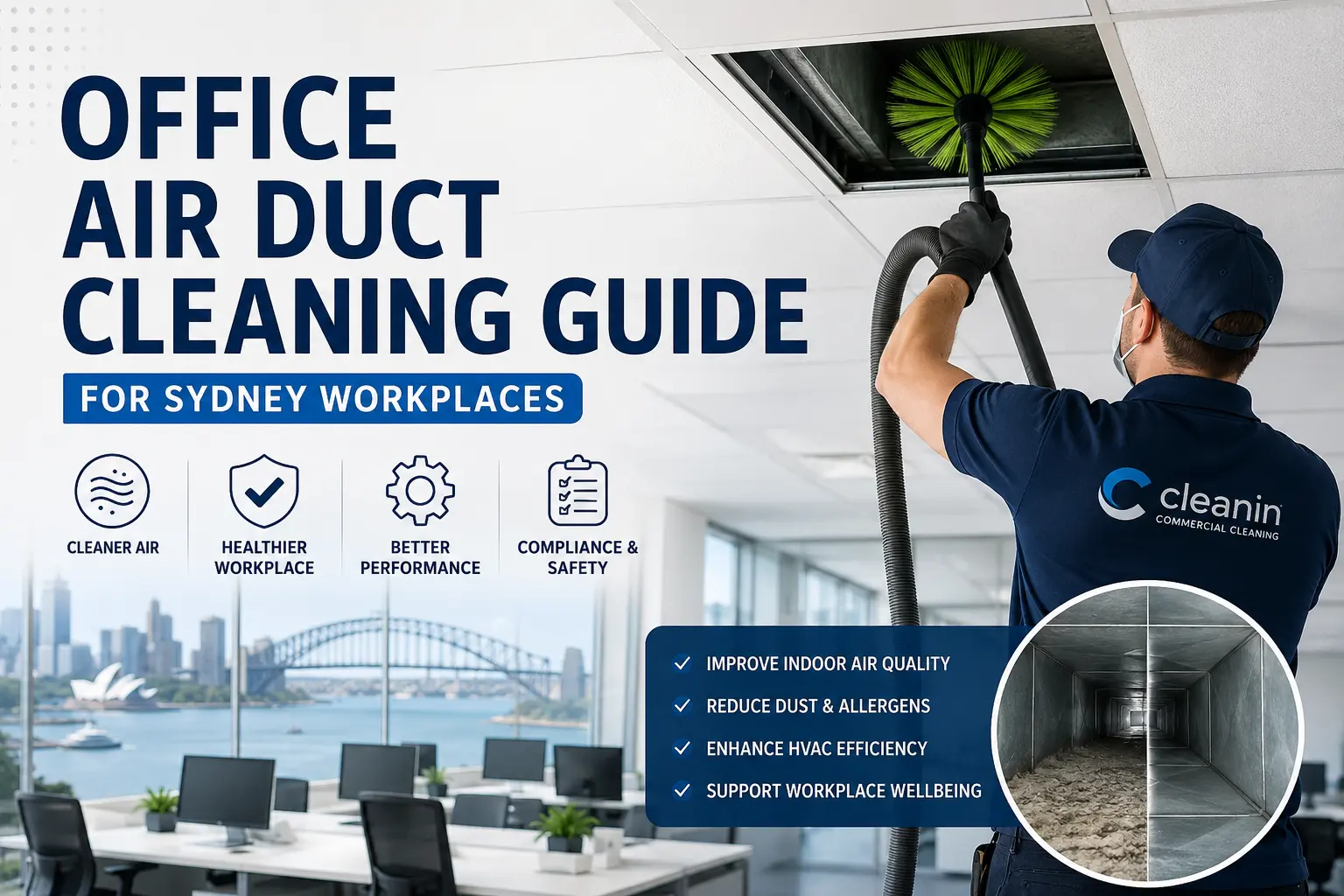
Office air duct cleaning typically begins with an inspection of the ductwork, often using a camera or borescope to assess contamination levels, identify mould growth, and confirm duct condition before work starts. This inspection stage determines the scope of cleaning required and identifies any sections needing repair or resealing alongside the cleaning itself.
Once scope is confirmed, technicians typically use negative-pressure extraction equipment connected to the duct system to dislodge and capture debris, combined with rotary brush agitation to loosen contamination adhered to duct walls, particularly in sections with heavier buildup.
HEPA filtration is applied at the extraction point during this stage to capture dislodged particles before they can re-enter the office air, preventing the cleaning process itself from temporarily worsening air quality. Coils, diffusers, and return air grilles are typically cleaned as part of the same service, since these components are directly connected to the duct system and accumulate contamination at similar rates. A final inspection, often using the same camera equipment, confirms the ductwork has been cleared before the system is returned to normal operation.
Is Office Air Duct Cleaning a Compliance Requirement in NSW?
AS 1668.2 sets the mechanical ventilation standard that governs air quality and system hygiene expectations for buildings in NSW, including ventilation performance directly affected by duct condition. Facility managers maintain ductwork in line with this standard to support the building’s overall ventilation performance and occupant health obligations under workplace safety requirements, rather than treating duct cleaning as a standalone regulatory mandate separate from general building ventilation compliance.
Building owners and facility managers also carry a general duty under the Work Health and Safety Act 2011 (NSW) to provide a safe working environment for occupants, which extends to indoor air quality where poor ventilation creates a foreseeable health risk.
Duct condition is one contributing factor assessed as part of this broader ventilation performance obligation, alongside filter maintenance, outside air intake rates, and mechanical system servicing.
How Is Office Air Duct Cleaning Different from Standard Office Cleaning?
Standard office cleaning addresses visible surfaces and accessible components, including light dusting of vent covers and grilles as part of monthly preventive maintenance tasks covered under a typical commercial cleaning schedule. Office air duct cleaning addresses the internal ductwork itself, the supply and return air cavities, coils, and air handling components, a separate scope requiring specialised negative-pressure extraction equipment that general office cleaning does not use and is not designed to access.
Facility managers typically treat these as complementary but distinct services operating on different intervals. Routine office cleaning maintains visible surfaces, desks, floors, and accessible fixtures on a recurring daily-to-monthly schedule, while duct cleaning addresses the ventilation system on a longer, condition-based interval determined by inspection rather than routine frequency. Neither service substitutes for the other, since visible surface cleanliness does not indicate duct condition, and duct cleaning does not address day-to-day surface hygiene.
Get Professional Commercial Cleaning for Your Sydney Workplace
Air duct cleaning is a specialised service, so the right approach starts with understanding your HVAC system and the condition of the areas that need attention.
Cleanin provides commercial cleaning services across Greater Sydney, helping facility and property managers maintain different types of commercial facilities. Office air duct cleaning can form part of a broader cleaning program where specialist HVAC cleaning is required.
Whether you manage a corporate office, shared workspace, professional facility or another commercial property, Cleanin can help you identify the appropriate cleaning scope for your workplace.
Looking for a reliable commercial cleaning company for your Sydney workplace? Talk to Cleanin about your facility requirements and request a quote.
Frequently Asked Questions
How much does office air duct cleaning cost in Sydney?
Cost depends on duct system size, the number of supply and return points, contamination level identified at inspection, and building access requirements, including ceiling height and whether ducts run through occupied or plant room areas. Current service packages outline available pricing structures for facility and property managers.
How long does office air duct cleaning take?
Duration depends on the size of the HVAC system, the number of duct runs and diffusers involved, and the extent of contamination present at inspection, with larger commercial systems and heavier contamination requiring more extraction time than a smaller, single-zone office setup.
Does an office need to be vacated during duct cleaning?
No, office doenot need to be evacuated during duct cleaning.
Does duct cleaning affect general office cleaning schedules?
Duct cleaning operates on a separate, condition-based interval from routine office cleaning and does not replace daily, weekly, or monthly cleaning tasks covered under a standard office cleaning scope. Facility managers in Greater Sydney can review these routine tasks in the commercial cleaning frequency guide.
Can poor duct condition affect HVAC system performance, not just air quality?
Debris buildup inside ductwork restricts airflow, which can force the HVAC system to work harder to maintain temperature and ventilation targets. Over time, this added strain can increase energy use and reduce the operational lifespan of fans, coils, and other mechanical components connected to the duct system.