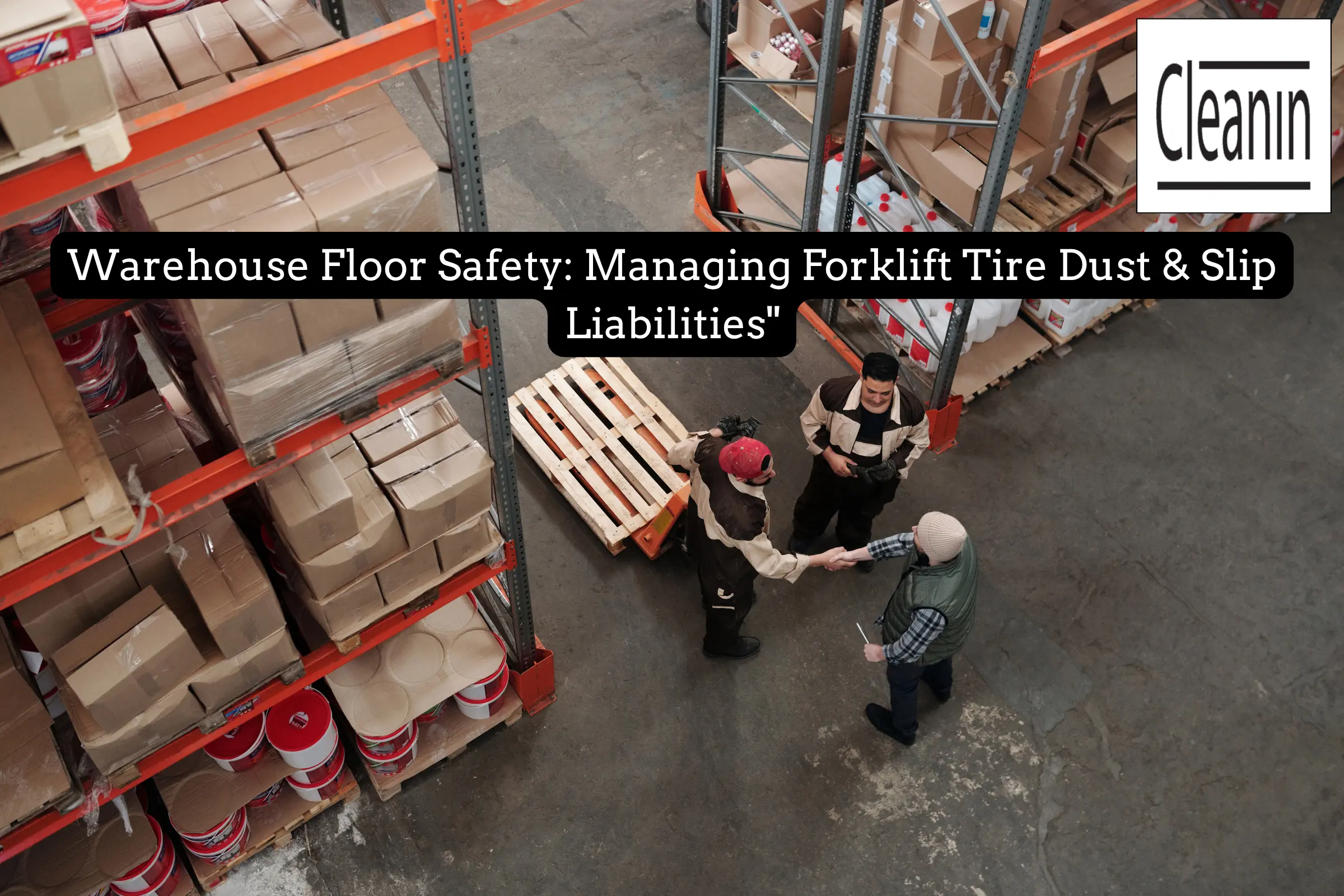
Forklift tyres leave more behind than the black scuff marks visible on a warehouse floor. They shed fine rubber particulate along every route they travel, and that loose dust sits on the floor surface where it reduces traction underfoot. A floor rated as slip-resistant when it was installed can still become a slip hazard once a layer of tyre dust builds up across a turning circle or a loading dock entry.
This matters beyond housekeeping. Under the WHS Act 2011, a warehouse operator has a duty to manage a foreseeable slip risk so far as reasonably practicable, and a build-up of tyre dust in a high-traffic zone is exactly the kind of foreseeable hazard that duty covers. Facility and property managers running distribution and storage sites across Greater Sydney need a warehouse cleaning service that treats forklift tyre dust as a slip-safety issue, not just an appearance one. This article explains where tyre dust comes from, why it creates a slip hazard, and what a cleaning program needs to include to manage the liability that comes with it.
What Is Forklift Tyre Dust, and Where Does It Come From?
Forklift tyre dust is the fine rubber particulate worn off forklift tyres as they move across a warehouse floor, along with tread residue left behind under load. It comes from the constant friction between tyre and floor surface, and it concentrates wherever forklifts turn, brake, or manoeuvre most.
The dust forms through 2 related processes. Repeated movement under heavy load wears fine particles off the tyre surface, which settle as loose dust on the floor. At turning points, the heat generated by tyres pivoting against the floor also bonds a portion of that rubber directly onto the surface, which is what leaves the visible black marks. The loose dust and the bonded marks come from the same source, but they behave differently once they’re on the floor, a distinction that matters for how each is managed.
Tyre dust doesn’t spread evenly across a warehouse. It concentrates at the points where forklifts work hardest: turning circles where tyres pivot, racking ends where forklifts change direction, loading dock entries where they transition between surfaces, and staging areas where they manoeuvre repeatedly in a confined space. These predictable deposit patterns mean tyre dust management can be targeted at specific zones rather than treated as an even, floor-wide problem.
Why does forklift tyre dust create a slip hazard?
Forklift tyre dust creates a slip hazard because a layer of fine loose particulate sitting on a hard floor reduces the grip between a shoe or tyre and the surface underneath. The floor’s underlying slip resistance may be adequate, but the dust layer on top of it lowers the traction actually available to anyone walking or driving across it.
A slip resistance rating measures the floor surface itself, not the surface plus whatever has accumulated on it. A concrete or sealed floor rated to a given standard under AS 4586 or AS 4663 delivers that rated grip only when the surface is clean. Once fine tyre dust builds up, it acts as a loose layer between foot and floor, reducing the effective grip below what the rating suggests. This is why a floor that passed its slip resistance classification at installation can still become a slip hazard in service, the rating didn’t change, but the condition of the surface did.
The hazard is higher in exactly the zones where tyre dust concentrates. A turning circle or loading dock entry combines the heaviest dust deposition with frequent foot and vehicle movement, which means the reduction in traction happens precisely where people and forklifts are most active. Fine tyre dust also has an airborne dimension when disturbed, though the immediate slip risk comes from the loose layer settled on the floor surface.
What Is the Difference Between Loose Tyre Dust and Bonded Tyre Marks?
Loose tyre dust is made up of fine rubber particles sitting on top of the floor, while bonded tyre marks are rubber residue adhered to the surface through repeated forklift turning and friction. Loose dust is the immediate slip factor and can be removed through routine cleaning. Bonded marks are more firmly attached and generally require scrubbing or degreasing to remove.
The two forms come from the same source but require different responses. Loose dust sits on the surface and can be lifted by sweeping or vacuuming. This directly helps reduce the slip hazard because the loose layer can reduce traction underfoot. Bonded marks are firmly attached to the floor and will not usually come away through routine sweeping. Removing them requires mechanical scrubbing, often with a suitable degreasing agent, to loosen the residue before it can be lifted.
The slip-safety priority sits with the loose dust, not the visible black marks. Bonded marks are mainly a surface-appearance and condition-assessment issue. Heavy accumulation can obscure damage or wear underneath, but it does not create the same loose-layer traction problem as settled dust. This distinction matters when scoping a cleaning program. A program that only targets visible marks for appearance may leave the loose dust that actually contributes to the slip risk unaddressed, while a program that regularly removes loose dust can manage the hazard even if some bonded marking remains.
What Slip-Safety Duty Applies to a Warehouse Floor Under NSW Law?
Under the WHS Act 2011 (NSW), a person conducting a business or undertaking (PCBU) must manage risks to health and safety so far as is reasonably practicable. This can include foreseeable slip hazards on a warehouse floor. Where tyre dust predictably builds up in high-traffic areas, it becomes a floor contamination risk that should be identified and managed as part of the site’s broader WHS system.
The Standard Is Reasonable Management, Not Perfection
The duty is not to prevent every incident. It is to take reasonably practicable steps to manage known and foreseeable risks. Tyre dust accumulating around turning areas and dock entries is foreseeable because it develops in predictable patterns during normal forklift operations. This means a warehouse operator should have a system for identifying and addressing the buildup rather than waiting for an incident to expose the hazard.
Documentation Is What Demonstrates the Duty Was Met
A documented cleaning and inspection routine can provide evidence that reasonably practicable risk-management steps were being taken. It helps show that the hazard was actively monitored and addressed rather than left unattended. A warehouse with consistent records showing when and where tyre dust was inspected and removed has clearer evidence of its risk-management process than one relying on ad hoc cleaning with no records.
The Duty Covers Workers and Visitors Alike
The duty to manage health and safety risks can extend beyond the operator’s own employees to other people who may be affected by the business or undertaking. A slip caused by unmanaged floor contamination can therefore create risks for workers, contractors, customers, and other visitors. This is why a documented cleaning system can serve both as a practical hazard-control measure and as evidence of how the risk was being managed.
Which Warehouse Zones Need the Most Frequent Tyre Dust Management?
The zones needing the most frequent tyre dust management are the areas where forklifts turn, change direction, move between surfaces, or manoeuvre repeatedly. These include turning circles, racking ends and aisle intersections, loading dock entries, and staging areas. These four zones can accumulate heavier dust deposits while also experiencing high levels of foot and vehicle traffic.
Turning Circles and Pivot Points
Turning circles can collect heavy tyre dust because pivoting under load creates increased friction between the tyre and floor. Both loose dust and bonded marks can build up quickly in these areas. Reduced traction is particularly relevant here because forklifts are changing direction, which requires greater control than travelling in a straight line.
Racking Ends and Aisle Intersections
Racking ends and aisle intersections are points where forklifts slow down, turn, and cross paths with other vehicles and pedestrians. Dust can concentrate here through repeated direction changes. These areas can also bring forklift and foot traffic into close proximity, increasing the potential consequences of reduced floor traction.
Loading Dock Entries and Transition Points
Loading dock entries can combine tyre dust with contamination tracked in from outside, including water, mud, and grit carried on tyres between the yard and warehouse floor. This combination makes dock entries variable slip-risk areas because the level and type of contamination can change with weather conditions and traffic rather than remaining constant.
Staging and Marshalling Areas
Staging and marshalling areas see forklifts manoeuvring repeatedly in confined spaces while loading, unloading, and repositioning stock. This can deposit tyre dust across a concentrated area. These zones also combine vehicle movement with workers on foot handling stock, placing people and forklifts in the same dust-affected space.
How Should a Warehouse Cleaning Program Manage Forklift Tyre Dust?
A warehouse cleaning program should manage forklift tyre dust by regularly removing loose dust to control the slip hazard, addressing bonded marks periodically through scrubbing or degreasing, and setting cleaning frequency by zone rather than applying one schedule across the entire floor. Loose dust is the main contributor to the immediate slip risk, so it determines how frequently the floor needs attention.
Removing Loose Dust
Loose dust can be cleared by sweeping or vacuuming. This directly helps manage the slip hazard by removing the loose layer that can reduce traction. Filtered vacuuming can capture fine dust rather than redistributing it, which is particularly useful for smaller particles that a broom may push across the floor instead of collecting. This task needs to be performed most frequently because loose dust can quickly re-accumulate wherever forklifts operate.
Addressing Bonded Tyre Marks
Bonded marks can be addressed periodically through mechanical scrubbing, often with a suitable degreasing agent to loosen the residue before it is removed. This can follow a longer cleaning cycle than loose dust removal because bonded marks generally build up more gradually and do not present the same immediate loose-layer traction issue. Wet scrubbing also requires proper water recovery because leaving the floor wet, or turning dry dust into slurry, can create a new slip hazard instead of removing the existing one.
Zone-Based Cleaning Frequency
Cleaning frequency should follow the deposit pattern rather than a uniform schedule. High-deposit zones, such as turning circles, dock entries, and racking ends, generally require more frequent loose-dust removal than low-traffic floor areas away from forklift routes. Matching cleaning frequency to where dust actually concentrates helps manage the hazard efficiently, rather than over-servicing quiet zones while under-servicing the areas that generate the most contamination.
What should a facility manager confirm in a warehouse cleaning contractor’s floor-safety scope?
A facility manager should confirm that the contractor targets high-deposit zones by name, distinguishes loose dust removal from bonded mark treatment, and documents when and where cleaning happened. These 3 points separate a cleaning scope that manages slip liability from one that only addresses floor appearance.
Zone-Specific Coverage
A floor-safety scope should name the high-deposit zones, turning circles, racking ends, dock entries, staging areas, and set a frequency for each, rather than quoting a single sweep of the whole floor. A scope that treats the floor as one uniform area tends to under-service exactly the zones where tyre dust concentrates and the slip risk is highest.
Loose Dust and Bonded Marks Handled Separately
A contractor should be able to explain how loose dust removal and bonded mark treatment are scheduled differently, since the loose dust drives the slip hazard and the bonded marks are a periodic surface issue. A scope that only mentions removing visible tyre marks may leave the loose dust that actually reduces traction unaddressed.
Documented Cleaning and Inspection Records
A contractor should provide records of when and where cleaning occurred, not treat this as internal paperwork unavailable to the client. This documentation is what supports a warehouse operator’s position that reasonably practicable steps were taken to manage a foreseeable hazard, which is why record-keeping is part of the floor-safety scope, not separate from it.
Manage Tyre Dust as a Slip Liability, Not Just a Floor Mark
Loose forklift tyre dust reduces traction where forklifts and workers move most, and managing it is part of a warehouse operator’s WHS duty, not just its housekeeping. Cleanin scopes warehouse floor cleaning by zone across Greater Sydney, separating regular loose-dust removal from periodic bonded-mark treatment, and documenting when and where each clean happened.
Request an on-site assessment and quote for a warehouse floor-safety cleaning scope built around where tyre dust actually concentrates.
For the cleaning methods behind this, see our comparison of warehouse floor sweeping versus auto-scrubbing. For the broader slip-and-fall liability framework, see our guide to floor safety ratings and slip-and-fall liability.