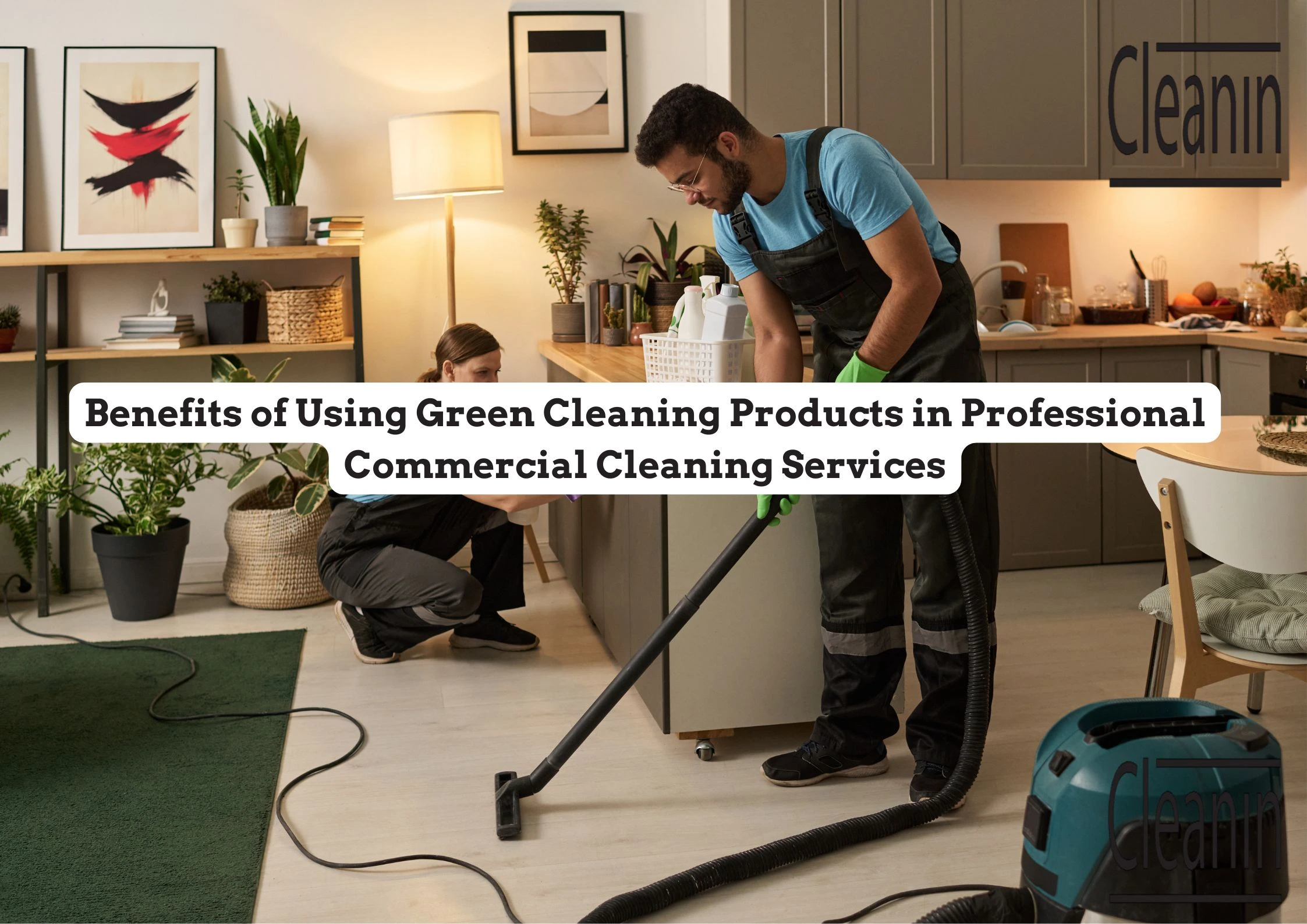
Green cleaning products are cleaning agents used in commercial cleaning services that are formulated to reduce harm to human health and the environment, while meeting recognised certification standards such as GECA or ECA. Green cleaning products help improve indoor air quality, reduce chemical exposure for occupants, support WHS cleaning compliance, and contribute to sustainability frameworks like NABERS and Green Star.
For Greater Sydney businesses and facility managers, green cleaning products are no longer simply an environmental preference. They have become an important part of professional commercial cleaning service delivery, helping businesses improve workplace hygiene, support occupant health, meet sustainability requirements, and align with WHS compliance obligations.
As more commercial buildings across Greater Sydney operate under NABERS ratings, Green Star frameworks, and stricter tenant sustainability expectations, the cleaning products used in commercial cleaning services now influence building performance, indoor air quality, and regulatory reporting.
Understanding how professional commercial cleaning services use verified green cleaning products across different facility types is essential for business owners, facility managers, and property operators evaluating service scope and contractor capability.
This guide explains how green cleaning products support professional commercial cleaning services, what measurable benefits they deliver across Greater Sydney commercial facilities, how to identify genuine certified products, and how Cleanin integrates verified green cleaning systems into its commercial cleaning service delivery.
What Are Green Cleaning Products in Commercial Cleaning?
Green cleaning products in commercial cleaning are cleaning agents formulated to minimise environmental impact and reduce human health risks, verified by a recognised certification standard.
Within a professional commercial cleaning service, product selection forms part of a broader compliance, hygiene, and risk management framework. Commercial cleaning service providers must ensure products are suitable for the facility type, aligned with applicable sustainability requirements, and supported by current Safety Data Sheet (SDS) documentation under the WHS Regulation 2017 (NSW).
In Australia, the primary certification frameworks for green cleaning products are Good Environmental Choice Australia (GECA) and Environmental Choice Australia (ECA). Products carrying these certifications must meet strict requirements for biodegradability, VOC limits, aquatic toxicity, restricted substances, and packaging sustainability.
The word “green” itself carries no legal definition in Australia. A cleaning product marketed as eco-friendly or natural may not meet any independently verified environmental standard.
A genuinely green cleaning product is defined by 5 verifiable attributes:
1. High Biodegradability
The active ingredients should break down into non-toxic compounds within a defined period, usually within 28 days under recognised OECD testing protocols. This reduces long-term environmental impact when cleaning products enter wastewater systems.
A contractor should be able to verify this through:
- GECA or ECA certification
- OECD 301B or 301F test results
2. Low VOC Content
Volatile Organic Compounds (VOCs) are chemicals that can affect indoor air quality and increase respiratory irritation. Green cleaning products should contain low VOC levels to help maintain healthier indoor environments for workers, tenants, visitors, and building occupants.
This is especially important for:
- Offices
- Schools
- Healthcare facilities
- Childcare centres
Verification should come through:
- GECA VOC compliance
- Product technical data sheets
- Green Star Indoor Environment Quality criteria
3. Low Aquatic Toxicity
Cleaning chemicals eventually enter wastewater systems. A genuinely green product should contain surfactants and active ingredients that meet strict aquatic toxicity limits to reduce environmental harm.
This helps minimise the downstream impact on water treatment systems and surrounding ecosystems.
Verification should come through:
- GECA certification
- ECA certification
- Product toxicity test documentation
4. Concentrated Formulation
Concentrated green cleaning products contain more active ingredients per litre.
This reduces:
- Packaging waste
- Transport emissions
- Storage requirements
- Plastic consumption
For commercial cleaning services managing large facilities, concentrated products also improve operational efficiency.
Verification can be confirmed through:
- Product SDS
- Manufacturer dilution specifications
- GECA packaging criteria
5. No Restricted Harmful Substances
A verified green cleaning product should be free from commonly restricted chemicals, such as:
- Phosphates
- Chlorine bleach
- Formaldehyde
- Triclosan
- Nonylphenol Ethoxylates (NPEs)
These substances are commonly restricted because they may contribute to respiratory irritation, chemical sensitisation, aquatic toxicity, or other health and environmental risks.
A contractor should verify this through:
- Product ingredient disclosure
- SDS documentation
- GECA restricted substance compliance
All green cleaning products still require a current Safety Data Sheet (SDS) under the WHS Regulation 2017 (NSW). Environmental certification does not remove WHS documentation obligations.
What Are the Benefits of Green Cleaning Products in Commercial Cleaning Services?
The 6 benefits of green cleaning products in commercial cleaning services are:
- Improved Indoor Air Quality — Lower VOC Exposure for Occupants
- Reduced Occupant Health Risk — Chemical Exposure Controls
- NABERS and Green Star Rating Contributions
- Reduced Environmental Impact — Biodegradability and Packaging
- WHS-Aligned Chemical Risk Profiles — Simpler Hazard Controls
- Supports ESG and Tenant Sustainability Reporting
Each benefit is tied to a specific operational, regulatory, or health outcome, not a general claim about sustainability.
Here is how each benefit applies to commercial facility management in Greater Sydney:
1. Improved Indoor Air Quality — Lower VOC Exposure for Occupants
Volatile Organic Compounds (VOCs) are emitted by conventional cleaning products during application and for hours after. In enclosed commercial environments like offices, schools, and healthcare facilities, VOC accumulation degrades indoor air quality and creates documented respiratory risks for occupants.
The World Health Organisation classifies formaldehyde, a VOC found in some conventional cleaning agents, as a Group 1 human carcinogen. Benzene, another VOC present in some solvent-based cleaning products, carries the same classification.
Green cleaning products certified under GECA apply VOC concentration limits that reduce occupant exposure to these compounds. For commercial facilities in Greater Sydney with NABERS Indoor Environment Quality (IEQ) obligations, reduced VOC cleaning products contribute directly to IEQ scoring.
| VOC source in conventional cleaning | Health risk to occupants | Green product control |
| Solvent-based degreasers | Headaches, dizziness, liver and kidney stress at sustained exposure levels | Plant-based solvent alternatives with low VOC profiles; GECA-certified formulations |
| Aerosol disinfectants | Respiratory irritation; asthma trigger; particulate inhalation | Trigger spray or concentrate formats with low-VOC active ingredients |
| Ammonia-based glass cleaners | Mucous membrane irritation; asthma exacerbation | VOC-free glass cleaning concentrates certified under GECA or ECA |
| Fragrance additives in surface cleaners | Sensitisation reactions; fragrance-related asthma triggers | Fragrance-free or naturally derived scent formulations with ingredient disclosure |
2. Reduced Occupant Health Risk — Chemical Exposure Controls
Many conventional cleaning products contain chemicals such as phosphates, chlorine bleach in high concentrations, triclosan, and nonylphenol ethoxylates (NPEs). These substances are linked to health risks over time, including skin irritation, breathing problems, and hormonal disruption with repeated exposure.
In commercial buildings where cleaning happens while people are present, such as schools, hospitals, retail centres, and open-plan offices, this exposure becomes a practical, everyday concern. Occupants may inhale residues in the air or come into contact with recently cleaned surfaces, especially when ventilation is limited or cleaning schedules overlap with working hours.
Green cleaning products certified under GECA are formulated without these restricted substances. This means the health benefit is not only dependent on how the product is used, but also on what is inside the product itself. In simple terms, the risk is reduced at the source, rather than managed only through cleaning practices or ventilation
3. NABERS and Green Star Rating Contributions
For Greater Sydney commercial facilities operating under a NABERS tenancy or whole-building rating, or targeting Green Star certification through the Green Building Council of Australia (GBCA), cleaning product specification contributes directly to the rating outcome.
| Rating system | Cleaning product relevance | Specific contribution |
| NABERS Indoor Environment | IEQ credit — cleaning product VOC content | Lower-VOC certified products improve IEQ score |
| NABERS Water | Concentrated product formulation reduces water use in dilution | Concentrated green products reduce rinse water volume |
| Green Star — Buildings | IEQ-15: Cleaning products credit | GECA-certified products directly satisfy IEQ-15 criteria |
| Green Star — Interiors | IEQ credit for cleaning and maintenance products | GECA or equivalent certification required for credit |
| Green Star — Performance | Ongoing building operations — cleaning product reporting | Annual cleaning product audit against certified product use |
For Greater Sydney facility managers managing NABERS-rated or Green Star-certified buildings, the cleaning contractor’s product specification is a rated building obligation, not a preference. Requesting GECA certification evidence from your cleaning contractor is a standard sustainability compliance step for rated facilities.
4. Reduced Environmental Impact — Biodegradability and Packaging
Conventional cleaning products that contain chemicals such as NPEs, phosphates, and synthetic surfactants can create environmental issues when they enter wastewater systems. In Greater Sydney, this wastewater is treated through Sydney Water’s network, but not all chemical compounds are fully broken down during treatment. As a result, some substances can still contribute to aquatic toxicity in the environment.
Green cleaning products certified under GECA are designed to break down more safely. They meet biodegradability standards based on OECD 301 testing methods, which means their active ingredients decompose into non-toxic substances within about 28 days under normal aerobic conditions. This helps reduce the chemical load that reaches waterways after treatment.
Another important environmental benefit comes from concentrated product formats. Because they contain more active ingredients in a smaller volume, they require less packaging, less transport, and less storage space. For example, one litre of a concentrated product can often replace up to ten litres of ready-to-use product, significantly reducing plastic use and overall supply chain impact.
5. WHS-Aligned Chemical Risk Profiles — Simpler Hazard Controls
Under the WHS Regulation 2017 (NSW), all hazardous cleaning chemicals used on commercial sites must have a current Safety Data Sheet (SDS), a risk assessment, and clearly documented safety controls before they are used.
Traditional cleaning products with higher hazard ratings, such as corrosive or highly toxic chemicals, usually require stricter handling. This can include more protective equipment, tighter storage conditions, and additional training for workers.
Green cleaning products certified under GECA are generally classified as lower risk compared to many conventional alternatives. They still require SDS documentation and must be handled correctly, but they are often simpler to manage in day-to-day operations. This is because they usually need less restrictive storage, fewer PPE requirements, and carry a lower likelihood of chemical-related incidents when used properly.
For facility managers, this translates into fewer chemical risks on site and a simpler WHS management process for the cleaning contractor. In practical terms, lower chemical risk can also help reduce workplace incidents, workers’ compensation claims, and exposure to SafeWork NSW compliance issues.
6. Supports ESG and Tenant Sustainability Reporting
Sustainability reporting is now a common requirement across commercial property management in Greater Sydney.
Many corporate tenants expect landlords and facility managers to show clear environmental performance through Environmental, Social, and Governance (ESG) reporting frameworks. This has made sustainability data a part of everyday facility operations, not just a reporting exercise.
Professional commercial cleaning services that use verified green cleaning products can directly support this requirement. They provide documentation and evidence that can be used in ESG and sustainability reports, such as GECA certification records, chemical ingredient disclosures, low VOC product data, information on sustainable packaging, and waste reduction details.
For property owners and strata managers, having this level of verified documentation helps strengthen tenant trust, improve leasing appeal, and support more credible and transparent sustainability reporting.
What Australian Certification Standards Apply to Green Cleaning Products?
Australia has 5 primary certification standards for green cleaning products. They are:
- Good Environmental Choice Australia (GECA)
- Environmental Choice Australia (ECA)
- EU Ecolabel (imported products)
- Green Seal (GS-37 / GS-53)
- EPA Safer Choice (USA)
Each 5 certification standards require third-party verification against criteria covering biodegradability, VOC content, aquatic toxicity, restricted substances, and packaging. GECA certification is recognised by NABERS and the Green Star rating systems operated by the Green Building Council of Australia.
For businesses and facility managers in Greater Sydney managing NABERS-rated buildings or Green Star-certified facilities, the certification standard of the cleaning product matters beyond the product itself. Using non-certified products on a rated building can affect the facility’s sustainability scoring and reporting obligations.
Let’s look into each certification standards that apply to green cleaning products.
| Certification | Administered by | Recognised by | Key criteria |
| Good Environmental Choice Australia (GECA) | GECA Australia | NABERS; Green Star (GBCA); government procurement frameworks | Biodegradability; VOC limits; aquatic toxicity; restricted substance exclusions; packaging |
| Environmental Choice Australia (ECA) | Environmental Choice Australia | Government and corporate procurement programmes | Biodegradability; ingredient disclosure; packaging minimisation |
| EU Ecolabel (imported products) | European Commission | Referenced in Australian procurement, not a domestic certification | Toxicity thresholds; biodegradability; performance standards |
| Green Seal (GS-37 / GS-53) | Green Seal (USA) | Referenced in some Australian building certifications | Institutional cleaning products; VOC and toxicity criteria |
| EPA Safer Choice (USA) | US Environmental Protection Agency | Referenced in multinational procurement, not an Australian certification | Institutional cleaning products: VOC and toxicity criteria |
GECA is the most directly relevant certification for Greater Sydney commercial facilities. It is the standard referenced in Australian Green Star credits and NABERS reporting frameworks. When evaluating whether a cleaning product genuinely meets sustainability obligations for a rated facility, GECA certification is the primary verification to request from your cleaning contractor.
How Do Green Cleaning Products Benefit Specific Commercial Facility Types in Greater Sydney?
Green cleaning products provide different primary benefits depending on the facility type. Healthcare facilities gain from reduced chemical sensitisation risk in clinical environments. Schools and childcare centres gain from lower VOC and restricted substance exposure for children. Office buildings with NABERS ratings gain from IEQ credit contributions. Strata complexes gain from reduced chemical residue in shared spaces used by a diverse occupant population.
The benefit profile of green cleaning products is not uniform across all facility types. Here is how the benefits apply by sector:
| Facility type | Primary benefit of green cleaning products | Relevant standard or framework |
| Office buildings (NABERS-rated) | VOC reduction contributes to IEQ score; GECA-certified products satisfy Green Star IEQ-15 credit | NABERS IEQ; Green Star IEQ-15 |
| Hospitals and medical centres | Reduced chemical sensitisation in clinical environments; fragrance-free formulations reduce occupant respiratory reactions | NSQHS Standard 3; AHPPC cleaning guidelines |
| Schools and universities | Restricted substance exclusion — no triclosan, NPEs, or high-VOC agents applied in spaces occupied by students during cleaning hours | Safe Work Australia education guidance; WHS Act 2011 NSW |
| Childcare centres | Formaldehyde-free, fragrance-free products; low aquatic toxicity surfactants — highest vulnerability occupant population | GECA restricted substance list; WHS Regulation 2017 NSW |
| Strata complexes | Reduced chemical residue in shared spaces; lower irritation risk for diverse occupant demographics including elderly residents | Strata Schemes Management Act 2015 NSW |
| Retail centres | Fragrance-free formulations reduce sensitisation in high-public-traffic areas; lower GHS hazard classification simplifies public safety controls | WHS Act 2011 NSW; WHS Regulation 2017 |
| Green Star / NABERS buildings | Direct certification credit contribution; auditable GECA product use records for annual performance reporting | Reduced chemical residue in shared spaces; lower irritation risk for diverse occupant demographics, including elderly residents |
How do you Verify Green Cleaning Products and Avoid Greenwashing?
Greenwashing occurs when cleaning products are marketed as natural, eco-friendly, or environmentally responsible without independent third-party certification.
For Greater Sydney businesses and facility managers evaluating a commercial cleaning service, product verification is an essential part of contractor assessment.
You can verify a genuine green cleaning product with 5 specific checks:
| Verification step | What to request | What a genuine product provides |
| Certification status | GECA or ECA certificate number and current expiry date | A searchable certification number on the GECA or ECA public register |
| SDS review | Current Safety Data Sheet (Australian version, no older than 5 years) | GHS hazard classification; ingredient disclosure; VOC content data |
| Restricted substance check | Ingredient list confirmed against GECA restricted substance schedule | No phosphates, triclosan, NPEs, formaldehyde, or high-VOC solvents listed |
| Biodegradability data | OECD 301 test result for primary surfactants | Test protocol and pass threshold documented in technical data sheet |
| Concentration ratio | Dilution instructions and active ingredient percentage | Test protocol and pass threshold documented in the technical data sheet |
Without this documentation, green product claims remain unverified.
A commercial cleaning service provider claiming to use green products should be able to provide GECA certificate numbers or equivalent for every product on their site SDS register and not a marketing brochure or a supplier’s ‘eco’ product range listing. If the contractor cannot provide this evidence, the green cleaning claim is unverified.
What Should a Sydney Facility Manager Ask a Commercial Cleaning Contractor About Green Products?
Greater Sydney’s businesses and facility managers should ask these 5 questions to a commercial cleaning service provider about green cleaning products:
1. Which Products Hold GECA or ECA Certification?
Ask the commercial cleaning company to provide a full product list with current certification numbers.
A verified commercial cleaning company should provide certification numbers that can be checked through the public GECA or ECA register.
Red flag:
The cleaning company only refers to terms like “eco-friendly,” “green,” or “environmentally safe” without providing certification evidence.
2. Can You Provide the Safety Data Sheet (SDS) for Each Product?
Every cleaning product used on your site should have a current Australian Safety Data Sheet.
The SDS confirms product ingredients, hazard classifications, safe handling procedures, and compliance with WHS Regulation 2017 (NSW).
Red flag:
The contractor cannot provide SDS documents, provides expired SDS records, or uses overseas product documentation that does not meet Australian requirements.
3. What Are the VOC Levels of the Products Used?
Low-VOC cleaning products help improve indoor air quality and reduce chemical exposure for building occupants.
A professional cleaning contractor should be able to provide VOC concentration data through the product SDS or technical data sheet.
Red flag:
The contractor claims products are “low VOC” but cannot provide actual figures or supporting documentation.
4. Are Restricted Substances Excluded from the Product Formulation?
Ask whether the products used are free from commonly restricted substances such as:
- Phosphates
- Triclosan
- Nonylphenol Ethoxylates (NPEs)
- Formaldehyde
A verified green cleaning contractor should provide ingredient disclosure or certification evidence confirming these substances are excluded.
Red flag:
The contractor avoids providing ingredient information or relies only on general green branding claims.
5. How Do Your Products Support NABERS or Green Star Requirements?
If your facility operates under NABERS or Green Star frameworks, your cleaning contractor should understand how their product selection contributes to sustainability reporting.
A professional contractor should explain exactly how their products support Indoor Environment Quality (IEQ) outcomes and provide the certification evidence needed for reporting.
Red flag:
The contractor is unfamiliar with NABERS, Green Star, or sustainability compliance requirements for commercial cleaning products.
How Does Cleanin Use Green Cleaning Products Across Greater Sydney Facilities?
Cleanin uses GECA-certified and low-VOC cleaning products as part of its commercial cleaning services across Greater Sydney. These products are selected to support both environmental performance and workplace safety standards.
Every product used on a Cleanin-managed site is recorded in the site’s Safety Data Sheet (SDS) register, along with its current certification status. This ensures full transparency and allows facility managers to verify exactly what is being used in their building at any time.
Facility managers also receive complete product specifications as part of the compliance documentation pack. This documentation can support NABERS Indoor Environment Quality (IEQ) reporting, Green Star certification requirements, and compliance with the WHS Regulation 2017 (NSW) for chemical management.
Cleanin’s use of green cleaning products is not based on marketing claims. It is an operational standard applied consistently across all facility types it services in Greater Sydney. Every engagement includes documented evidence of product selection and compliance to support facility managers in audits, reporting, and day-to-day operations.
Here is how Cleanin applies green cleaning products across its service scope:
Product Selection — Verified, Not Self-Declared
Cleanin selects cleaning products based on 3 criteria: GECA certification status or equivalent, GHS hazard classification level, and facility-type suitability. Products are not selected on the basis of supplier eco-labelling or marketing classification. Every product on a Cleanin site chemical register has a traceable certification or compliance basis.
SDS Register — Green Products Included
Every green cleaning product used by Cleanin on a commercial site is listed on the site’s SDS register. The SDS register is current (within the 5-year WHS Regulation 2017 NSW requirement), accessible at the point of use, and provided to facility managers as part of the compliance documentation pack. GECA certification status is noted alongside each product entry.
NABERS and Green Star Documentation Support
For Greater Sydney facilities operating under a NABERS or Green Star rating, Cleanin provides the product certification evidence needed to support IEQ credit documentation and annual performance reporting. Facility managers do not need to assemble this evidence independently as it is delivered as part of the standard Cleanin engagement documentation.
Facility-Type Product Matching
Cleanin matches green cleaning product selection to facility type. Healthcare facilities receive fragrance-free, AHPPC-compatible formulations. Schools and childcare centres receive products with confirmed absence of triclosan, NPEs, and formaldehyde. Strata complexes and retail centres receive low-VOC formulations suited to occupied or semi-occupied cleaning schedules.
Cleanin provides professional, green-product-integrated commercial cleaning services across office buildings, hospitals, schools, universities, strata complexes, retail centres, industrial facilities, and post-construction sites in Greater Sydney. Contact Cleanin at cleanin.com.au for a site assessment and written scope of works.
Request a green cleaning product specification for your Greater Sydney facility
Contact Cleanin for a site assessment and written scope of works. Cleanin, a commercial cleaning company in Greater Sydney, provides facility managers and property managers across Greater Sydney with documented, green-product-integrated commercial cleaning services with GECA certification evidence, SDS register, and NABERS/Green Star credit documentation provided on every engagement.