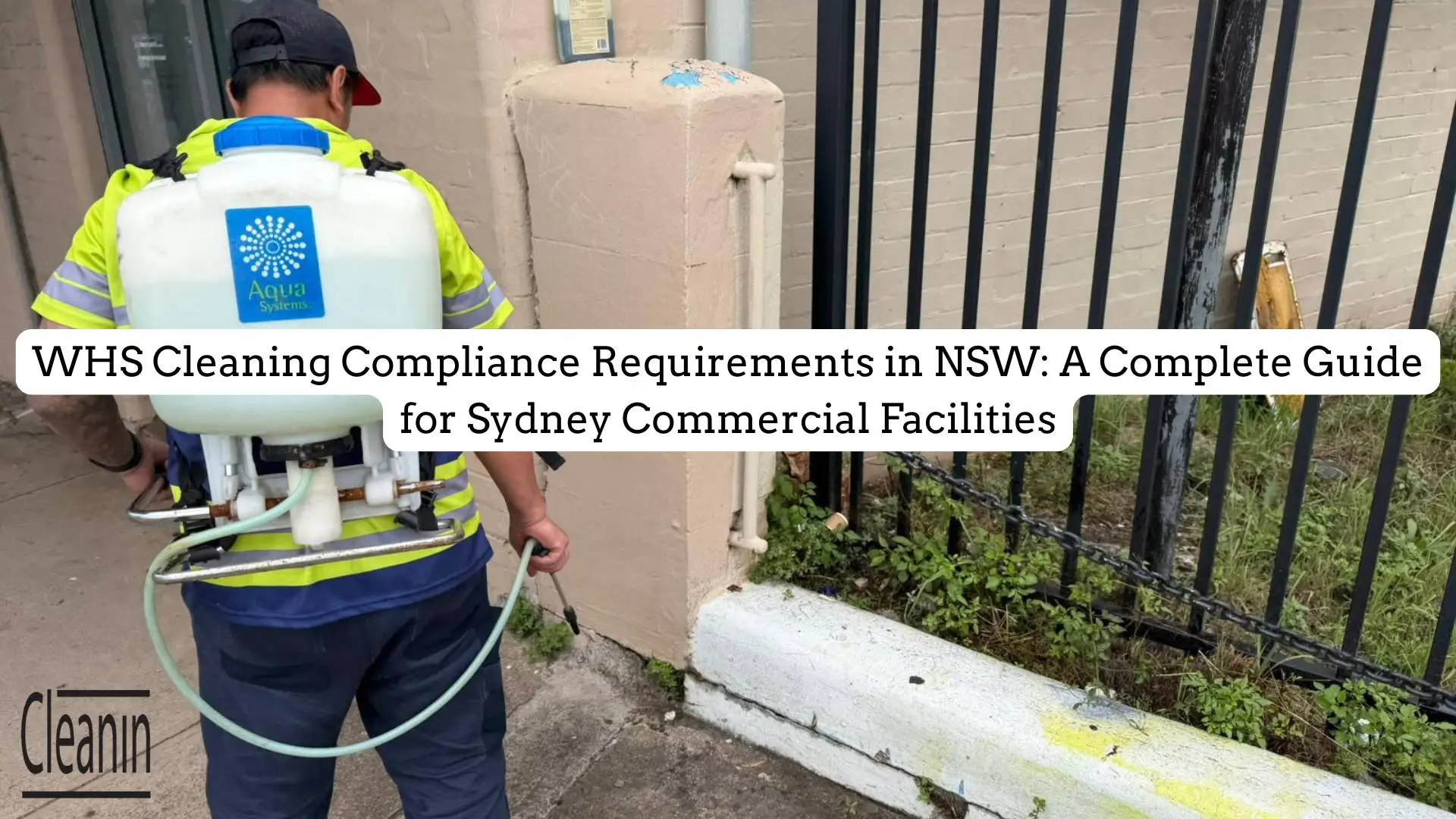
If you manage a facility or commercial property in Sydney, cleaning compliance is not just about keeping the workplace clean and presentable. It is a legal requirement under the Work Health and Safety Act 2011 (NSW).
Failure to meet cleaning compliance obligations can lead to enforcement action from SafeWork NSW, significant financial penalties, operational disruption, and legal responsibility for injuries to workers or building occupants.
This guide explains what WHS cleaning compliance means for Greater Sydney facilities, which obligations apply by facility type, and how hiring Cleanin, a commercial cleaning company with documented WHS systems, reduces the compliance burden on facility and property managers.
What Is WHS Cleaning Compliance in NSW?
WHS cleaning compliance in NSW means maintaining a clean, safe workplace as required by the Work Health and Safety Act 2011. PCBUs, facility managers, and cleaning contractors must identify, assess, and control cleaning-related hazards such as slip risks, chemical exposure, Manual handling injuries, Biological contamination, Airborne dust exposure, and Cross-contamination risks to protect workers and occupants.
According to the Work Health and Safety Act 2011 (NSW), the person conducting a business or undertaking (PCBU) is legally responsible for workplace safety. That means, in most Sydney commercial facilities, this responsibility sits with the building owner, facility manager, or the business occupying the space, not only the cleaning contractor.
Section 19 of the WHS Act requires PCBUs to keep the workplace safe as far as reasonably practical. Cleaning is directly named under this obligation. The Work Health and Safety Regulation 2017 (NSW) further specifies Slip prevention controls, Hazardous chemical storage, Manual handling procedures, Worker consultation, Incident reporting, Confined space cleaning, and PPE requirements.
Under NSW WHS law, PCBUs must also consult workers when cleaning-related hazards may affect their health and safety. This means workers should be involved when reviewing cleaning risks, updating procedures, or introducing new chemicals or equipment.
What are the Key WHS Legislation and Standards Applicable to Commercial Cleaning Services in NSW?
Commercial cleaning compliance in NSW is shaped by several legal and operational frameworks.
Hiring a commercial cleaning company that operates across all relevant compliance frameworks is the most reliable way to satisfy this obligation.
| Legislation / Standard | Scope | Relevant to Cleaning |
|---|---|---|
| Work Health and Safety Act 2011 (NSW) | Primary duty of care framework | All commercial facilities |
| WHS Regulation 2017 (NSW) | Specific hazard controls, PPE, chemicals | All cleaning operations |
| Safe Work Australia Cleaning Services Guide | Industry-specific practical guidance | Professional cleaning companies |
| AS/NZS 4146:2000 | Laundry and linen hygiene practices | Healthcare and hospitality |
| WHS Amendment (Crystalline Silica) Regulation 2024 | Engineered stone and silica dust control | Construction and post-renovation cleaning |
| AHPPC Cleaning Guidelines | Infection prevention and disinfection | Healthcare and high-risk facilities |
| Strata Schemes Management Act 2015 (NSW) | Common property obligations | Strata and residential complexes |
A facility manager must understand which obligations apply to their property type and cleaning activities.
Who Is Legally Responsible for Commercial Cleaning Service Compliance in a NSW Workplace?
Under the WHS Act 2011 NSW, the PCBU holds the primary duty of care for cleaning compliance. Facility managers, property managers, and cleaning contractors each carry overlapping obligations.
This is one of the most misunderstood points in Sydney’s commercial cleaning sector. Many facility managers assume the cleaning company carries all WHS risk. That assumption is incorrect under NSW law.
The WHS Act 2011 uses a ‘shared duty’ model. Multiple duty holders can be responsible for the same risk. Each must discharge their duty to the extent they have control.
Here is how responsibilities are typically distributed:
| Duty Holder | Primary Obligation | Practical Example |
|---|---|---|
| PCBU / Facility Manager | Provide safe premises and systems of work | Ensure wet floor signage is available and chemical storage areas are safe |
| Property Manager | Coordinate compliance across contractors and tenants | Verify contractor WHS documentation and insurance |
| Cleaning Contractor | Deliver compliant cleaning services | Provide trained staff, PPE, SDS, and SWMS |
| Workers | Follow safe work procedures | Use PPE correctly and report hazards immediately |
Cleanin operates as a compliant PCBU in its own right. Every Cleanin site engagement includes a documented Safe Work Method Statement (SWMS), chemical Safety Data Sheets (SDS), and a site-specific hazard identification record. Facility managers receive clear, auditable documentation of WHS due diligence, not a verbal assurance.
What Are the Specific WHS Hazard Controls Required for Commercial Cleaning Services in NSW?
These are the specific WHS hazard controls required for commercial cleaning services in NSW:
- Slip, Trip, and Fall Hazards
- Hazardous Chemical Exposure
- Manual Handling and Musculoskeletal Risks
- Biological Hazards and Infection Control
Each hazard has specific control hierarchy requirements under the WHS Act.
Safe Work Australia’s Cleaning Services Guide identifies the following as the most common causes of injury and illness in the commercial cleaning industry in Australia. Cleanin’s operational procedures are built directly around these control requirements for every Sydney facility type.
1. Slip, Trip, and Fall Hazards
Slip incidents are one of the most common causes of workplace injury in commercial facilities. WHS compliance requires:
- Wet floor signs are placed before cleaning begins
- Signs remaining in place until floors are dry
- Non-slip footwear for workers
- Spill response procedures
- Site-specific floor risk assessments
- Incident reporting for slip events and near misses
Near-miss reporting is especially important because it helps identify hazards before injuries occur.
2. Hazardous Chemical Exposure
The WHS Regulation 2017 (NSW) requires PCBUs to manage hazardous chemicals through the hierarchy of controls. For cleaning chemicals on Sydney commercial sites, this means:
- Safety Data Sheets (SDS) are stored and accessible at the point of use for every chemical product on site.
- Dilution ratios and application methods are documented per manufacturer specifications.
- Incompatible chemicals like acids and bleaches are stored separately and must never be stored adjacent to each other.
- Workers are trained in chemical handling before using any hazardous cleaning product
- PPE, including gloves, eye protection, and respiratory protection where required, must be provided and used by workers.
3. Manual Handling and Musculoskeletal Risks
Repetitive cleaning tasks like vacuuming, mopping, and scrubbing can lead to cumulative musculoskeletal strain over time. WHS controls include. WHS controls include:
- Ergonomic equipment selection, such as long-handled tools to reduce repeated bending
- Task rotation schedules for workers performing repetitive motions for extended periods
- Manual handling training completed before workers lift or move cleaning equipment heavier than 16 kg
4. Biological Hazards and Infection Control
Biological hazard controls are mandatory in healthcare, aged care, childcare, and food-handling facilities. Controls required include:
- Colour-coded microfibre cloth systems to prevent cross-contamination between zones.
- Correct Personal Protective Equipment (PPE), including gloves and fluid-resistant aprons, when handling bodily fluid waste.
- Compliance with Australian Health Protection Principal Committee COVID-19 surface decontamination guidelines for high-touch areas.
- Documented cleaning validation for clinical areas, including verification of disinfectant surface contact time.
What Does the WHS Amendment (Crystalline Silica) Regulation 2024 Mean for Commercial Cleaning After Construction in NSW?
The WHS Amendment (Crystalline Silica Substances) Regulation 2024 is one of the most important recent compliance changes for NSW commercial cleaning. It directly affects any Sydney facility that undergoes construction or renovation work involving engineered stone, concrete cutting, or masonry.
The WHS Amendment (Crystalline Silica Substances) Regulation 2024 (NSW) requires PCBUs to implement specific airborne dust controls when cleaning post-construction or renovation sites containing engineered stone or silica-containing materials. Dry sweeping or dry vacuuming without HEPA filtration is now a non-compliant method in NSW.
Crystalline silica dust that is generated when cutting, grinding, or demolishing silica-bearing materials causes silicosis, an incurable and potentially fatal lung disease.
The Regulation introduced 5 specific requirements for post-construction cleaning in NSW:
| Requirement | Detail | Non-Compliance Risk |
|---|---|---|
| Air monitoring | Required before and during cleaning where silica risk exists | Improvement or prohibition notice |
| Wet cleaning methods | Dry sweeping prohibited | Infringement notice |
| HEPA vacuuming | H-Class or M-Class filtration required | Regulatory breach |
| Respiratory PPE | Minimum P2 / N95 protection | WHS prosecution risk |
| Worker training | Must be documented | Stop-work order |
Cleanin’s construction cleaning operations across Greater Sydney are conducted in full compliance with the 2024 Crystalline Silica Regulation. Cleanin uses HEPA-rated vacuum equipment, wet cleaning protocols, and documented worker training records for every post-construction site engagement, providing facility managers with compliance coverage that dry cleaning methods cannot deliver.
What Are the WHS Cleaning Compliance Requirements by Facility Type in Greater Sydney?
WHS cleaning compliance requirements in NSW vary by facility type. Healthcare facilities follow NSQHS Standard 3 and Spaulding Classification. Schools follow Safe Work Australia’s education sector guidance. Strata properties follow the Strata Schemes Management Act 2015 (NSW). Each facility type carries distinct hazard profiles and documentation obligations.
A one-size-fits-all approach to WHS cleaning compliance does not reflect the regulatory environment in NSW. Cleanin services each of the facility types below using the specific compliance framework applicable to that property, not a generic cleaning scope applied across all sites.
| Facility Type | Primary Compliance Framework | Key Cleaning Requirement |
| Office buildings | WHS Act 2011 NSW; WHS Regulation 2017 | Slip hazard controls; chemical SDS on site; documented SWMS |
| Hospitals & medical centres | NSQHS Standard 3; Spaulding Classification; AHPPC Guidelines | Zone-based cleaning; surface contact time validation; ATP testing |
| Schools & universities | WHS Act 2011 NSW; Safe Work Australia education guidance | Colour-coded equipment; chemical lockaway; SWMS for high-risk tasks |
| Strata / residential complexes | Strata Schemes Management Act 2015 NSW; WHS Act 2011 | Common area hazard control; documented scope of works; insurance compliance |
| Retail centres | WHS Act 2011 NSW; WHS Regulation 2017 | Spill response SOPs; wet floor signage protocol; high-traffic surface frequency |
| Industrial facilities | WHS Act 2011 NSW; Safe Work Australia hazardous work guidance | Confined space cleaning SWMS; hazardous substance handling; PPE specification |
| Post-construction sites | WHS Amendment (Crystalline Silica) Regulation 2024 | HEPA vacuuming; wet methods; respiratory PPE; silica monitoring |
What Documentation Does a Greater Sydney Facility Manager Need to Demonstrate WHS Cleaning Compliance?
NSW WHS compliance requires facility managers to hold 4 core documentation categories:
- a current Safe Work Method Statement (SWMS) for high-risk cleaning tasks
- Safety Data Sheets (SDS) for all chemicals used on-site
- worker training records for cleaning staff
- a site-specific hazard register.
SafeWork NSW inspectors may request all 4 during a site visit.
Documentation is the primary evidence of WHS due diligence. If SafeWork NSW investigates an incident at a Sydney facility, documentation determines whether the PCBU met their duty of care or failed to meet it. Verbal assurances from a cleaning contractor are not sufficient.
Let’s break down 4 categories:
1. Safe Work Method Statement (SWMS)
A SWMS identifies high-risk construction work and cleaning tasks, lists the hazards involved, and documents the controls applied. High-risk tasks requiring a SWMS under NSW WHS Regulation include cleaning at heights, working in confined spaces, and post-construction cleaning involving silica-bearing materials.
2. Safety Data Sheets (SDS)
An SDS is required for every hazardous chemical used on site. SDS documents must be no older than 5 years, must be the Australian-market version, and must be accessible to workers at the point of use and not stored in a back office only.
3. Worker Training Records
Training records must confirm that each cleaning worker has been trained in the specific hazards and controls for the site they are working on. Generic induction records are not sufficient for high-risk tasks.
4. Hazard Register and Inspection Records
A site hazard register documents identified risks, assigned controls, and scheduled review dates. Regular cleaning inspections with dated records demonstrate active risk management rather than passive compliance.
Cleanin provides facility managers with a complete compliance documentation pack for each site: SWMS, SDS register, training confirmation, and a documented scope of works. This reduces the compliance burden on the facility manager directly.
What Are the Penalties for WHS Cleaning Non-Compliance in NSW?
WHS penalties in NSW are significant and have recently been updated to reflect higher enforcement standards. On 1 July 2024, New South Wales increased maximum penalties under the Work Health and Safety Act 2011 (NSW) to ensure they remain a credible deterrent.
These penalties apply to PCBUs, facility managers, building owners, and, in some cases, cleaning contractors where breaches occur.
The enforcement system is structured into three main offence categories, depending on the level of risk and negligence involved.
Many facility managers underestimate enforcement risk because they have not experienced a SafeWork NSW site visit. Safe Work Australia and SafeWork NSW both publish prosecution results publicly. WHS cleaning non-compliance has resulted in prosecutions of both PCBUs and cleaning contractors in NSW.
| Offence Category | Description | Maximum Penalty (Corporation) | Individual / Officer Penalty |
|---|---|---|---|
| Category 1 | Reckless conduct or gross negligence exposing a person to risk of death or serious injury | $4,089,178 | $817,835 + possible imprisonment |
| Category 2 | Failure to comply with WHS duty that exposes a person to risk of death or serious injury | $2,044,589 | Varies under WHS Act provisions |
| Category 3 | Failure to comply with WHS duty (no serious risk involved) | $681,530 | Varies under WHS Act provisions |
These penalties demonstrate how seriously WHS compliance is treated in NSW, especially in high-risk environments such as commercial cleaning, healthcare facilities, and post-construction sites.
Enforcement Notices (Issued Without Court Conviction)
SafeWork NSW inspectors can issue enforcement notices during a site visit without requiring a court conviction. These are the most common first enforcement steps in commercial cleaning compliance inspections.
| Notice Type | When It Is Issued | Effect | Legal Outcome if Ignored |
|---|---|---|---|
| Improvement Notice | When a WHS breach is identified | Requires corrective action by a set deadline | Failure to comply can lead to prosecution |
| Prohibition Notice | When there is a serious risk to health or safety | Stops work immediately until risk is removed | Stops work immediately until the risk is removed |
Public Prosecution and Shared Liability
WHS enforcement in NSW is also highly transparent. SafeWork NSW maintains a Public Prosecution Register where all enforcement outcomes are published.
A key legal principle under the WHS system is shared responsibility.
Both PCBUs and contractors can be held liable for the same incident if their actions or failures contributed to the risk.
| Area | Key Point |
|---|---|
| Public Reporting | SafeWork NSW maintains a public Prosecution Register for WHS offences |
| Shared Liability | Both PCBUs and contractors can be prosecuted for the same incident |
| Legal Principle | Engaging a contractor does not transfer WHS responsibility away from the PCBU |
| Common Risk Issue | Facility managers often fail to verify contractor SWMS, training, and safety systems |
This is especially relevant in commercial cleaning, where multiple parties operate across the same site.
Facility managers are expected to verify contractor compliance before work begins.
Key Compliance Takeaway
For Sydney facility managers, WHS cleaning compliance is not just about avoiding fines. It is about actively managing legal risk across contractors, staff, and workplace systems.
| Insight | Explanation |
|---|---|
| Higher Financial Exposure | Penalties now exceed $4 million for serious corporate breaches |
| Stronger Enforcement Powers | Inspectors can shut down unsafe work immediately |
| Shared Legal Responsibility | Liability applies to both PCBUs and contractors |
| Verification Duty | Contractor WHS systems must be checked, not assumed |
How Does Cleanin Ensure WHS Compliance for Sydney Facility Managers?
Cleanin operates as a compliant PCBU under the WHS Act 2011 NSW. Every site engagement includes a site-specific SWMS, SDS register, trained staff with documented inductions, and a scope-of-works record. Facility managers receive documentation that satisfies SafeWork NSW due diligence requirements for commercial cleaning.
Facility and property managers across Greater Sydney hire Cleanin as their commercial cleaning company because a clean facility alone does not satisfy WHS obligations. They need documented, defensible WHS compliance.
Cleanin delivers this through 5 operational standards applied on every site:
- Site-specific SWMS prepared before work commences on any new or modified engagement.
- Chemical SDS register maintained and accessible on site for every hazardous product in use.
- Worker inductions documented for each site, covering the specific hazards and controls relevant to that facility type.
- Colour-coded cleaning equipment deployed to prevent cross-contamination in high-risk zones across all facility types.
- HEPA-rated vacuum equipment used on every post-construction or renovation engagement in compliance with the 2024 Crystalline Silica Regulation.
Cleanin provides commercial cleaning services to corporate office buildings, strata complexes, schools, universities, retail centres, hospitals, industrial facilities, and post-construction sites across Greater Sydney. Each service is delivered within the compliance framework relevant to that facility type, not a standard scope applied uniformly across all sites.
Ready to meet your WHS cleaning compliance obligations?
Contact Cleanin for a site compliance assessment. Cleanin provides facility managers across Greater Sydney with the documentation, trained staff, and compliance processes needed to satisfy Work Health and Safety Act 2011 (NSW) requirements for commercial cleaning across every facility type Cleanin services.