Commercial cleaning agents are chemical substances (usually liquids, powders, sprays, or granules) formulated to remove soils, dust, stains, foul odors, bacteria, grease, and clutter on surfaces in commercial environments. Commercial cleaning agents are concentrated, surface-specific, and formulated to meet regulatory and infection control standards. They differ based on surface type, contamination level, and facility requirements. Each cleaning agent is used in commercial cleaning services based on its cleaning purpose, safety requirements, and compatibility with the surface being treated.
Using the wrong cleaning agent on the wrong surface causes measurable damage. It can degrade floor finishes, corrode fixtures, leave chemical residue on food-contact surfaces, or fail to meet the disinfection standard required in regulated facilities.
What are the Types of Commercial Cleaning Agents?
The types of commercial cleaning agents are:
- Detergents
- Disinfectants
- Degreasers
- Descalers and Acid Cleaners
- Neutral Cleaners
- Alkaline Cleaners
- Abrasive Cleaners
1. Detergents
Detergents are the foundational cleaning agents in any commercial cleaning service. Detergents work by reducing surface tension between water and soil, lifting grease, oils, and particles from surfaces so they can be rinsed away. Every professional clean starts with detergent because it removes the soil load before any disinfection step begins.
Detergents come in neutral, alkaline, and acidic formulations, each suited to a different soil type. Detergent cleans surfaces but does not disinfect them. In facilities with infection control requirements, detergent is always the first step and not the final one.
2. Disinfectants
Disinfectants are powerful chemical cleaning agents specifically formulated to kill pathogens and prevent the spread of bacteria, viruses, fungi, and molds on surfaces. They are among the strongest commercial cleaning agents, designed to achieve a higher level of microbial control than sanitizers.
The most widely used types of disinfectants in commercial cleaning are quaternary ammonium compounds, sodium hypochlorite, and accelerated hydrogen peroxide formulations.
3. Degreasers
Degreasers are alkaline or solvent-based agents formulated to break down and dissolve heavy grease, cooking oil, and fat deposits. They are used in commercial kitchens, food manufacturing facilities, warehouses, and other environments where grease accumulation occurs.
Standard detergents do not have sufficient chemical strength to emulsify heavy grease loads. A degreaser breaks apart the grease molecule so it can be agitated and rinsed clear. Bio-enzymatic degreasers are increasingly used in commercial restaurant and kitchen areas because they break down organic material without the surface and fume risks associated with solvent-based products.
4. Descalers and Acid Cleaners
Descalers are acid-based agents that dissolve mineral scale, limescale, calcium deposits, rust, and uric acid buildup. They work through a neutralisation reaction where the acid reacts with alkaline mineral compounds and converts them into water-soluble salts that rinse away.
Descalers are most commonly used in commercial spaces like restrooms, on tapware and toilet bowls, in commercial dishwashers, and on tiled surfaces with heavy hard water buildup. They are a periodic cleaning product and not a daily one. Overuse of acid cleaners degrades grout lines, dulls chrome finishes, and damages natural stone surfaces over time.
5. Neutral Cleaners
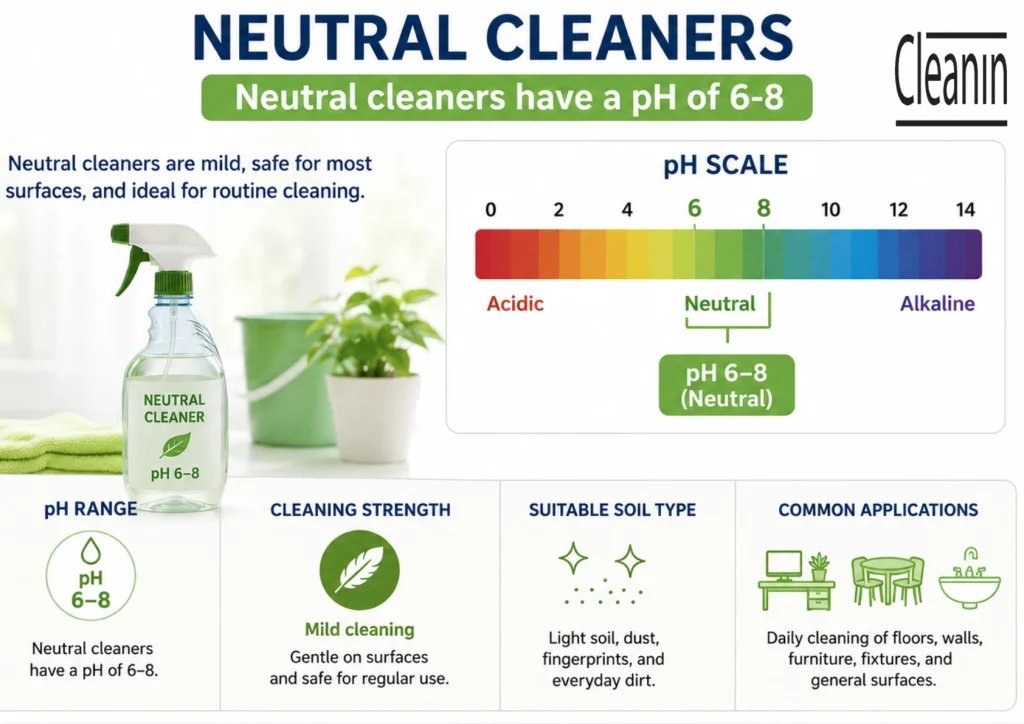
Neutral cleaners have a pH of 6-8 and are designed to effectively remove dirt and grime without causing chemical damage to surfaces. Neutral cleaners are mild cleaning agents used for sensitive surfaces like vinyl, timber, laminate, and polished flooring in offices, strata buildings, and commercial interiors. They clean effectively without damaging surface finishes.
6. Alkaline Cleaners
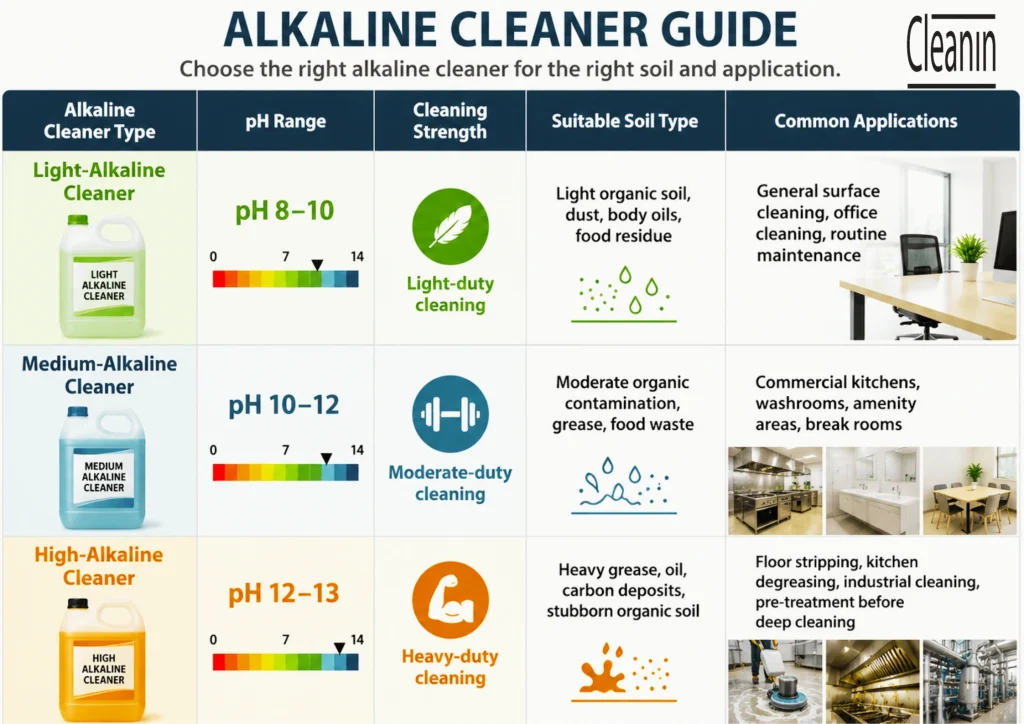
Alkaline cleaners have a pH above 7, typically ranging from pH 8 to pH 13 depending on the formulation strength. Alkaline cleaners remove heavy organic soils such as cooking residue, grease, body oils, and industrial contamination.
Alkaline cleaners are one of the most widely used chemical agents in commercial cleaning because they effectively remove organic contaminants such as cooking residue, body oils, food waste, and grease. The formulation of alkaline cleaners is matched to the strength of the soil load.
7. Abrasive Cleaners
Abrasive cleaners are cleaning agents that contain physical or chemical abrasive particles used to remove stubborn soil, surface staining, carbonised deposits, rust marks, and ingrained contamination that chemical action alone cannot lift.
Abrasive cleaners work by creating controlled friction on the surface, which helps lift bonded contamination such as burnt food, scuff marks, and heavy industrial residue. They are commonly used on durable surfaces that can tolerate mechanical cleaning action.
Abrasive cleaners are not suitable for delicate surfaces because strong abrasion can damage finishes such as polished flooring, painted surfaces, and soft coatings.
To maximize efficiency, these chemical agents must be paired with the correct Tools and equipment in commercial cleaning services, such as microfiber cloths, floor scrubbers, and industrial applicators.
How to Select the Right Commercial Chemical Agents for Cleaning Services?
These are the ways to select the right commercial cleaning agents:
- Surface Type
- Contamination Level
- Facility Type
- Safety and Compliance Requirements
1. Surface Type
Surface type is the primary factor in deciding which cleaning agent can be used safely and effectively.
It also determines how a cleaning agent interacts with the material. Sensitive materials such as vinyl, timber, and laminate require mild neutral cleaners because stronger chemicals can damage their surface finish. Harder surfaces such as concrete and industrial flooring can tolerate stronger alkaline or degreasing agents because they are built for heavy-duty cleaning conditions.
When surface compatibility is considered early, cleaning becomes more controlled and prevents long-term damage.
2. Contamination Level
The type of soil or contamination level determines how strong the cleaning agent needs to be.
Light dust and everyday dirt are handled with detergents because they break down general soil without harsh chemical action. Microbial contamination in shared environments requires disinfectants because hygiene control becomes the priority. Grease, oil, and heavy residue demand degreasers because they are designed to break down oil-based buildup. Stubborn or bonded contamination may require abrasive cleaners because physical scrubbing is needed when chemical action alone is not enough.
Matching cleaning strength to contamination level improves efficiency and reduces unnecessary chemical use.
3. Facility Type
Different environments operate under different hygiene expectations, which directly influence chemical selection.
Healthcare and childcare environments rely heavily on disinfectants because infection control is critical. Office environments typically use neutral cleaners because appearance and daily maintenance are the main focus. Commercial kitchens require degreasers because grease accumulation is frequent. Industrial and warehouse environments often depend on alkaline cleaners because contamination levels are higher and more complex.
Facility type ensures cleaning practices align with operational risk and hygiene standards.
4. Safety and Compliance Requirements
Every cleaning agent must align with workplace safety requirements before it is used in a commercial setting.
Safety Data Sheets define correct handling, dilution ratios, and exposure limits. Dilution systems help maintain consistent chemical strength and reduce risk during application. Low-toxicity products are preferred in sensitive environments where occupants include children, patients, or high-traffic users.
Safety compliance ensures cleaning processes remain controlled, predictable, and safe for both workers and building occupants.