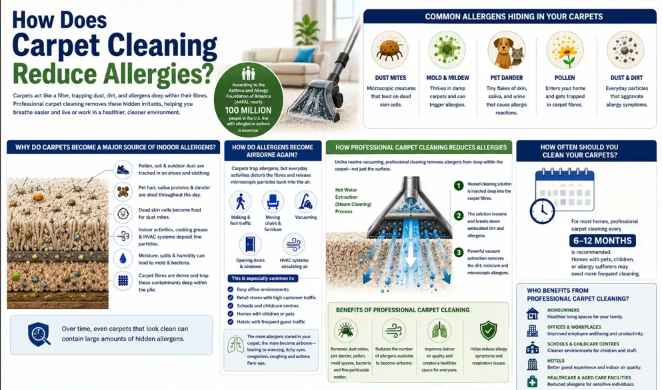
Professional carpet cleaning reduces allergies by removing the microscopic allergens that become deeply embedded within carpet fibres before they can continuously circulate through indoor air. Dust mites, pet dander, pollen, mold spores, bacteria, dead skin cells and fine particulate matter naturally accumulate in carpets as people move throughout a home or commercial building. Although carpets initially trap these particles and prevent them from remaining airborne, they eventually become one of the largest reservoirs of indoor allergens. Every footstep, vacuum pass, chair movement or airflow from an HVAC system can disturb these trapped contaminants and release them back into the breathing zone where they may trigger allergic reactions or worsen respiratory conditions.
According to the Asthma and Allergy Foundation of America (AAFA), nearly 100 million people in the U.S. live with allergies or asthma making indoor allergen control an essential part of maintaining healthier indoor environments.
For homeowners, this means allergy symptoms such as sneezing, itchy eyes, nasal congestion, coughing and asthma flare-ups may persist even when the carpet appears clean. For commercial property owners, facility managers, office administrators, schools, healthcare facilities, hotels, childcare centres and aged care providers, neglected carpets can negatively affect indoor air quality, occupant comfort, workplace wellbeing and the overall cleanliness of the environment. Professional carpet cleaning addresses these hidden contaminants by removing them from deep within the carpet structure rather than simply cleaning the visible surface.
Unlike routine vacuuming which mainly removes loose debris from the top of the carpet, professional cleaning reaches the lower layers where allergens gradually accumulate over months or even years. Deep cleaning methods such as hot water extraction (steam cleaning) inject heated cleaning solution into the carpet fibres to loosen embedded contaminants before immediately extracting them using powerful vacuum systems. This process removes not only visible dirt but also microscopic allergenic particles that household equipment typically cannot reach. As a result, there are fewer allergens available to become airborne, contributing to healthier indoor air and reducing exposure for everyone who occupies the space.
Why Do Carpets Become a Major Source of Indoor Allergens?
Many people assume that allergies are caused by airborne dust alone. In reality, carpets continually collect allergens from multiple sources every day making them one of the largest indoor reservoirs of microscopic contaminants.
Each time someone enters a building, they introduce particles that eventually settle into the carpet. Shoes track in pollen, soil, vehicle emissions, pesticides and outdoor dust. Clothing carries fibres and environmental particles from outside. Pets shed hair, saliva proteins and dander throughout the day while people naturally release thousands of dead skin cells every hour. These skin cells become a primary food source for dust mites which thrive in warm, humid carpet fibres and produce allergenic waste particles.
Indoor activities also contribute to allergen accumulation. Cooking releases grease particles that attract dust, opening windows allows pollen and airborne pollutants to enter and heating or air conditioning systems continuously circulate fine particulate matter that eventually settles into the carpet. Moisture from spills, humidity or inadequate drying can further encourage mould spores and microbial growth beneath the carpet surface.
Because carpet fibres consist of dense loops and twisted yarns, these contaminants do not remain on the surface. Instead, they migrate deeper into the pile with repeated foot traffic where they become increasingly difficult to remove using standard household cleaning methods.
Over time, even carpets that appear visually clean may contain significant concentrations of allergens hidden beneath the surface.
How Do Allergens Become Airborne Again?
A common misconception is that once dust settles into the carpet, it remains there permanently. In reality, carpets experience a continuous cycle of trapping and releasing microscopic particles.
Whenever someone walks across the floor, moves office chairs, vacuums, opens doors or when HVAC systems circulate air throughout the building, the carpet fibres flex and release fine particles back into the surrounding air. Many of these particles are too small to be seen by the naked eye but remain suspended long enough to be inhaled by occupants.
This process is particularly noticeable in:
- Busy office environments with constant employee movement.
- Retail stores experiencing high customer traffic.
- Schools and childcare centres where continuous activity disturbs carpet fibres.
- Homes with children or pets that generate frequent movement.
- Hotels where luggage, cleaning equipment and guest traffic continually agitate carpets.
The more allergens stored within the carpet, the greater the amount that can become airborne during everyday activities.
This explains why individuals with allergies often experience symptoms indoors despite maintaining an otherwise clean-looking property.
How Professional Carpet Cleaning Removes Allergy Triggers?
Professional carpet cleaning targets allergens at their source rather than temporarily improving the carpet’s appearance.
Specialised commercial equipment combines mechanical agitation, cleaning solutions, heated water and high-powered extraction to remove contaminants from deep within the carpet pile. Instead of pushing dirt further into the fibres or redistributing fine particles into the room, professional systems physically extract the contaminants from the carpet.
During a professional clean, the process removes:
- Dust mites hiding deep within carpet fibres along with their allergenic waste.
- Pet dander and microscopic skin flakes that continue causing allergic reactions long after pets leave the room.
- Pollen particles are brought indoors through footwear, clothing, and ventilation systems.
- Fine dust and airborne particulate matter that settle into the carpet over time.
- Dead skin cells and organic debris that encourage dust mite populations.
- Mould spores and microbial contaminants associated with damp carpets.
- Bacteria and other microscopic pollutants that contribute to poor indoor hygiene.
Because these contaminants are physically extracted instead of merely displaced, the carpet contains substantially fewer allergenic particles after cleaning.
How Cleaner Carpets Improve Indoor Air Quality?
Indoor air quality depends on far more than ventilation alone. Every soft surface inside a building including carpets, rugs, upholstery and curtains acts as both a collector and potential source of airborne particles.
When carpets become overloaded with contaminants, normal daily activity repeatedly releases microscopic allergens into the surrounding air. This continuous recirculation increases the concentration of airborne particles that occupants breathe throughout the day.
Professional carpet cleaning interrupts this cycle by significantly reducing the amount of allergenic material stored within the carpet itself. With fewer contaminants available to become airborne:
- Indoor dust levels gradually decrease.
- Airborne allergen concentrations become lower.
- HVAC systems circulate cleaner air.
- Occupants experience fewer respiratory irritants.
- The indoor environment feels cleaner and fresher.
For commercial buildings, improved indoor air quality also contributes to a healthier workplace, greater occupant comfort and better overall building hygiene.
Who Benefits Most from Professional Carpet Cleaning?
Although every property benefits from cleaner carpets, some environments experience greater improvements because occupants spend extended periods indoors or are more sensitive to allergens.
| Property Type | How Carpet Cleaning Helps |
| Homes | Creates a healthier environment for families, particularly children, older adults and allergy sufferers. |
| Offices | Reduces airborne dust, improves employee comfort and supports healthier indoor workplaces. |
| Healthcare Facilities | Helps maintain higher hygiene standards by removing contaminants from patient areas. |
| Schools & Childcare Centres | Reduces allergen exposure where children spend long hours indoors. |
| Hotels & Accommodation | Improves guest comfort while maintaining cleaner indoor environments between stays. |
| Aged Care Facilities | Supports better respiratory health for elderly residents who are often more vulnerable to airborne allergens. |
Carpet Cleaning Is One Part of an Allergy Management Strategy
While professional carpet cleaning significantly reduces allergen levels, it works best as part of a broader indoor air quality strategy. Regular vacuuming with a HEPA-filter vacuum, prompt spill removal, humidity control, adequate ventilation, HVAC filter maintenance and scheduled professional deep cleaning all contribute to lowering allergen exposure.
For most residential properties, professional carpet cleaning every 6 to 12 months helps maintain healthier carpets. Commercial buildings with heavy foot traffic may require cleaning every 3 to 6 months to prevent allergen build-up and maintain indoor air quality.
By removing the hidden contaminants that ordinary cleaning leaves behind, professional carpet cleaning transforms carpets from a long-term source of allergens into a cleaner, healthier flooring surface. The result is improved indoor air quality, reduced allergen exposure and a more comfortable environment for occupants in both residential and commercial settings.
FAQs
1. Does carpet cleaning help reduce allergies?
Yes. Professional carpet cleaning removes dust mites, pollen, pet dander and other allergens trapped deep within carpet fibres.
2. How often should carpets be professionally cleaned to reduce allergens?
Homes should be cleaned every 6 to 12 months, while commercial properties usually benefit from cleaning every 3 to 6 months.
3. Can dirty carpets affect indoor air quality?
Yes. Dirty carpets can trap allergens and release them back into the air during everyday activities like walking or vacuuming.
4. Which carpet cleaning method is best for allergy sufferers?
Hot water extraction is one of the most effective methods for removing deep-seated allergens and contaminants.
5. Is vacuuming enough to remove allergens from carpets?
No. Vacuuming removes surface debris but professional carpet cleaning is needed to extract allergens embedded deep within the carpet.