Commercial kitchen equipment collects grease, steam, heat, and food residue during every service. Left unmanaged, that buildup creates hygiene failures, fire risks, and equipment breakdowns. The catch is that each piece of equipment fails differently and needs a different fix. A deep fryer needs a full boil-out with a purpose-built cleaner. An exhaust canopy filter needs an alkaline degreaser soak that has nothing to do with the duct system behind it. A grease trap needs cleaning when accumulated FOG hits 25% of capacity, not because a date on a calendar says so.
Structured commercial kitchen equipment cleaning is essential not just for appearance but also for food safety, fire prevention, compliance, and operational efficiency. A commercial cleaning service uses food-safe chemicals, specialised equipment, and industry-specific cleaning methods to manage these requirements consistently.
This guide explains how to clean commercial kitchen equipment, how often cleaning should be performed, the cleaning chemicals commonly used, and the mistakes to avoid to keep equipment hygienic, safe, and operating efficiently.
What Is Commercial Kitchen Equipment?
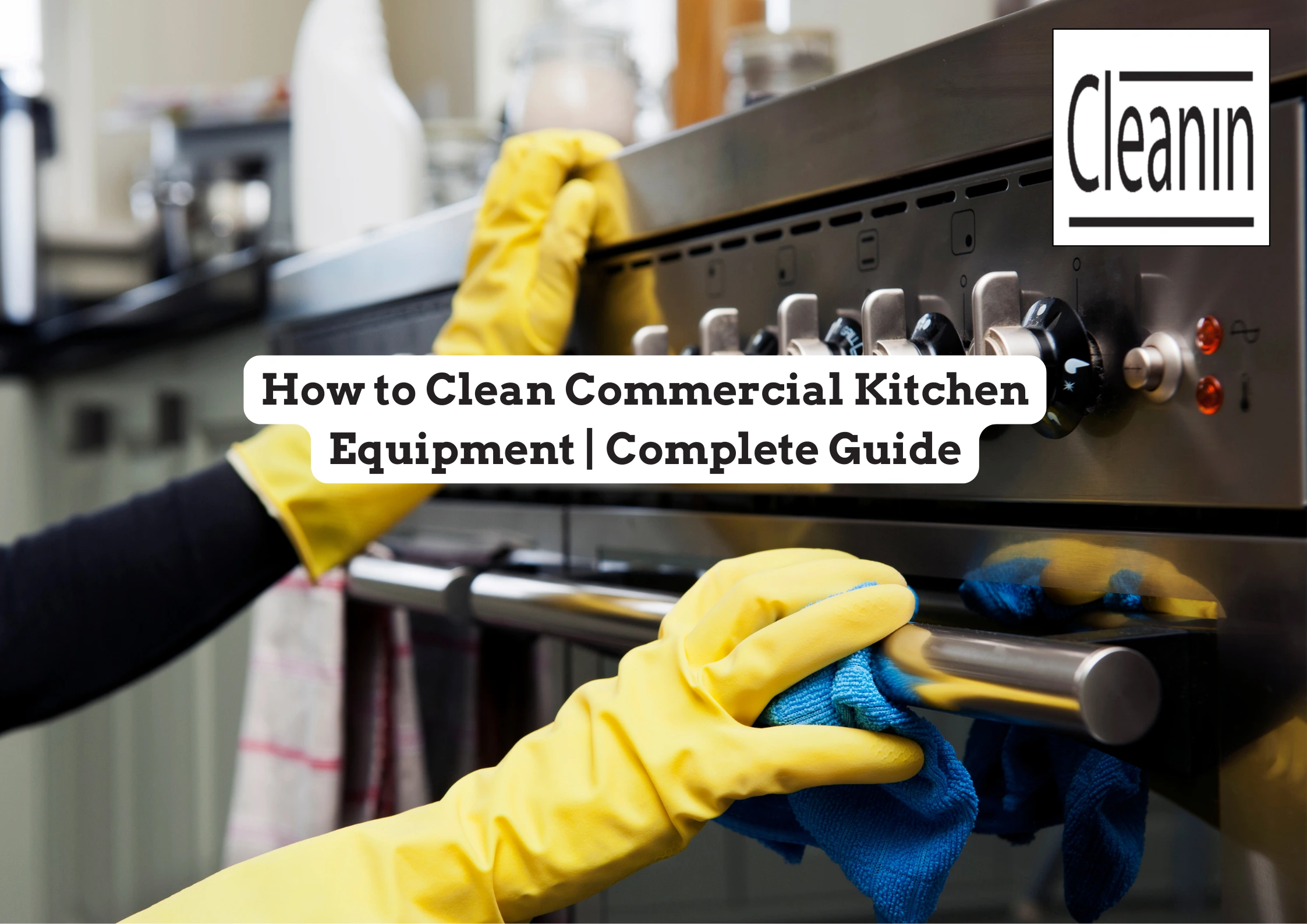
Commercial kitchen equipment refers to all appliances, surfaces, and systems used to prepare, cook, store, and clean food in a commercial kitchen: ovens, fryers, grills, cooktops, refrigerators, dishwashers, stainless steel benches, and ventilation systems like exhaust hoods and ductwork.
These kitchens run constantly and push through large volumes of food. That means more grease, more carbon buildup, more moisture, and more bacteria than any home kitchen produces. Regular cleaning with food-safe products is what keeps that under control.
Because of this intensity, commercial kitchen equipment requires regular cleaning using specialised food-safe products and methods to maintain hygiene and performance standards.
How to Clean Different Commercial Kitchen Equipment Step By Step?
Cleaning commercial kitchen equipment follows a structured process based on equipment type, contamination level, and the safety requirements for that surface. A commercial cleaning service typically uses food-safe degreasers, sanitising agents, steam cleaning systems, and purpose-specific tools for each equipment category.
The best ways to clean different commercial kitchen equipment are:
1. Commercial Ovens and Ranges
Commercial ovens and ranges require an alkaline degreaser applied to cool surfaces at the correct dilution, a dwell time of 10 to 30 minutes for heavy carbon buildup, a full water rinse to remove chemical and grease residue, and a final wipe-down before the equipment returns to food service.
Carbon buildup on oven interior walls, door seals, and rack surfaces forms through repeated exposure to fat vapour at high temperatures. Alkaline degreasers dissolve this buildup through a saponification reaction with fat molecules. The degreaser must be applied while the oven is fully cool. Applied to a warm surface, it evaporates before the dwell time completes, reducing efficacy and leaving chemical residue behind.
The cleaning processes for commercial ovens and ranges follow 6 steps:
- Confirm the oven is fully cool before applying any chemical.
- Remove racks and soak them separately in alkaline degreaser solution at the concentration specified on the product SDS.
- Apply alkaline degreaser to interior walls, door seal, floor, and ceiling using a cloth or low-pressure spray. Do not spray onto electrical components, thermostat probes, or door seal gaskets.
- Allow the product to dwell for the time specified on the SDS, typically 10 minutes for routine buildup, up to 30 minutes for heavy carbon accumulation.
- Scrub loosened carbon with a stiff non-metallic brush. Metal scrapers damage stainless steel linings and create surface scoring that traps carbon in subsequent cycles.
- Rinse twice with clean water using a wrung-out cloth, removing all chemical and dissolved grease before the oven returns to service.
2. Commercial Grills and Flat Tops
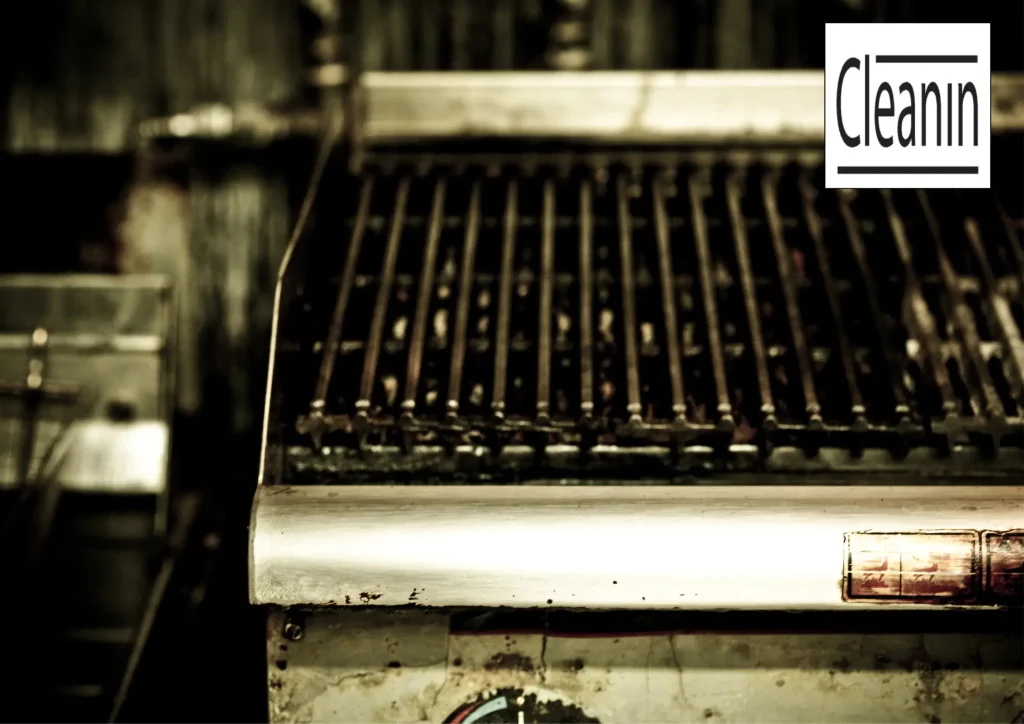
Commercial grills and flat tops require scraping while the surface is still warm, alkaline degreaser application after it cools to a safe handling temperature, a water rinse to remove chemical residue, and a food-safe oil wipe on seasoned cast iron and steel surfaces to prevent corrosion between services.
Cleaning a grill while hot causes chemical products to volatilise on contact, cutting dwell time below the level needed for effective degreasing. Cleaning a fully cold surface causes solidified grease to resist removal. The correct temperature is warm, typically 40 to 60 degrees Celsius.
The cleaning sequence for commercial grills and flat tops follows 7 steps:
- Allow the surface to cool to 40 to 60 degrees Celsius after the last service.
- Scrape the full surface using a grill scraper or flat top spatula, working from the back toward the grease channel at the front.
- Direct all scraped debris into the grease channel and remove it.
- Apply alkaline degreaser at the dilution on the product SDS. Allow the full dwell time, typically 5 to 15 minutes.
- Scrub with a grill brick on cast iron grill plates, or a non-metallic scour pad on stainless flat tops. Metal scour pads on stainless surfaces produce scratches that trap carbon in subsequent cooking cycles.
- Rinse with clean water to remove all chemicals and dissolved grease.
- Apply a thin wipe of food-safe cooking oil to seasoned cast iron and carbon steel surfaces after rinsing. This prevents oxidation between services and maintains the seasoned layer that reduces food adhesion.
Commercial Fryer
A commercial fryer requires two cleaning types: a daily exterior and basket clean after each service, and a full boil-out once or twice per week in high-volume operations. The boil-out removes polymerised oil residue and carbon buildup from tank walls and heating elements that daily cleaning cannot reach.
The fryer boil-out process follows 7 steps in sequence:
- Allow fryer oil to cool to below 40 degrees Celsius.
- Drain all oil into a sealed disposal container.
- Remove and soak fryer baskets in alkaline degreaser solution separately.
- Fill the fryer tank with water and add the manufacturer-recommended boil-out chemical at the specified ratio.
- Heat the solution to operating temperature, typically 90 to 95 degrees Celsius, and hold for 20 to 30 minutes.
- Drain the boil-out solution, rinse the tank twice with clean water, and inspect for residual carbon.
- Dry the tank fully before refilling with fresh oil. Any residual moisture causes violent oil splatter when heated.
Fryer exterior surfaces, control panels, and side panels are wiped down daily with alkaline degreaser and a food-safe cloth. Fryer baskets are cleaned separately. Carbon and food residue accumulate in basket wire joints and require brush cleaning with a dedicated basket brush.
Commercial Exhaust Canopies and Hood Filters
Commercial exhaust canopy hood filters require weekly removal and degreaser soaking or a commercial dishwasher cycle. Canopy interior surfaces and grease channels require weekly degreasing. The duct system behind the canopy requires deep cleaning by a professional service at a minimum of quarterly for high-volume kitchens and semi-annually for moderate-volume operations.
Grease-saturated hood filters restrict airflow, reduce ventilation effectiveness, and create a direct fire hazard. Grease accumulation in exhaust ducting is the primary cause of commercial kitchen fires in Australia. The duct cleaning schedule must be documented and retained as evidence of fire risk management.
Commercial exhaust canopies and hot filters cleaning require these 6 processes:
- Remove all filter cassettes from the canopy housing.
- Submerge filters in alkaline degreaser solution at the concentration on the product SDS, typically for a minimum of 30 minutes for heavily loaded filters.
- Agitate filters during soaking to dislodge loosened grease.
- Run through a commercial dishwasher cycle at 60 degrees Celsius minimum, or rinse manually with hot water and a stiff brush.
- Inspect for damage to filter mesh or frame before reinstalling.
- Reinstall only when fully dry. Wet filters installed into a hot canopy create steam and accelerate grease redeposition
Canopy interior and grease channel cleaning: Apply alkaline degreaser to interior surfaces, allow dwell time, and wipe down with a clean cloth or brush. Confirm grease channel drain points are clear after every service to prevent grease overflow onto cooking equipment below.
Commercial Refrigeration and Cold Room Equipment
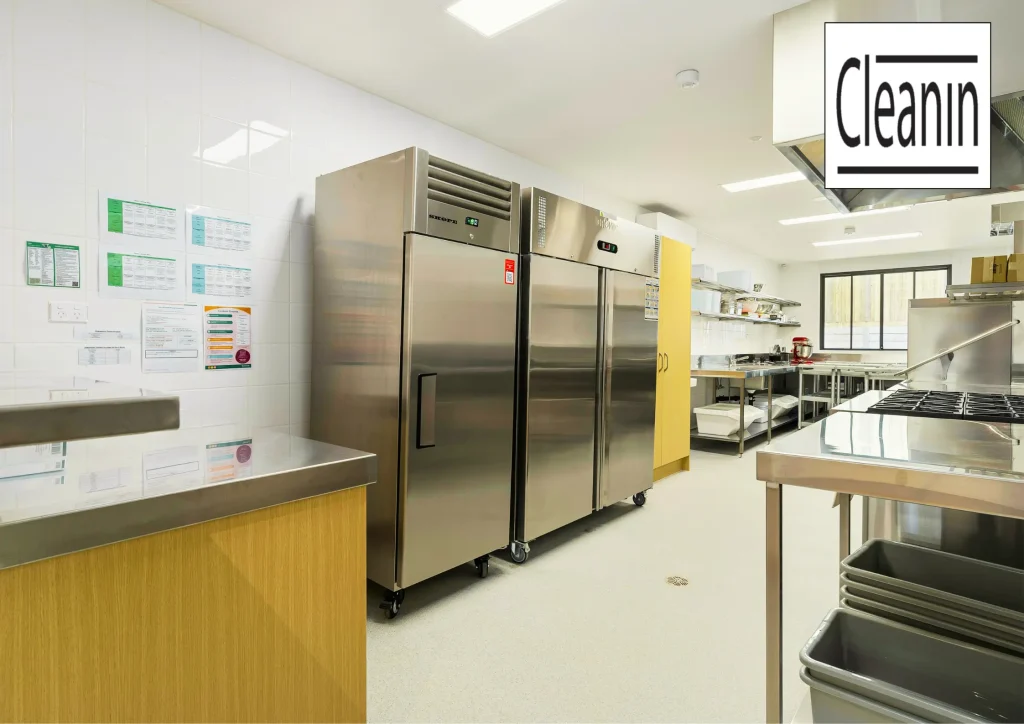
Commercial refrigeration units and cold rooms require a full clean once per week, covering interior floor surfaces, shelving, door seals, drain areas, and condensation panels. ATP testing of cold room surfaces in poorly maintained units returns results of 200 or more RLU. Properly maintained cold rooms return 5 to 8 RLU on Hygiena luminometers.
The gap between these two figures reflects bacterial biofilm growth on cold, moist surfaces where organic matter accumulates from product spills, condensation, and ice buildup. Cold environments slow but do not stop bacterial growth. Listeria monocytogenes is the primary pathogen of concern in cold storage environments, as it remains viable and replicates at temperatures as low as 0 degrees Celsius.
Commercial cold room cleaning requires these 8 processes:
- Remove all products and transfer to a compliant temporary storage area.
- Switch off refrigeration units where safe, or work around active refrigeration with cold-environment cleaning products.
- Remove shelving and wash in an alkaline detergent solution in a designated cleaning area.
- Clean floor surfaces with a pH-neutral detergent suited to cold-environment application. Alkaline products that lose effectiveness at near-zero temperatures will not achieve the required result.
- Clean wall and ceiling panels with a damp microfibre cloth and food-safe detergent. Avoid abrasive pads that damage panel surfaces and create bacterial harbourage points.
- Apply enzymatic drain treatment to floor drain lines to break down fat and protein biofilm in drain channels.
- Wipe door seals with food-safe sanitiser. Door seals are the highest-contact surface in a cold room and the first area to show visible mould growth when cleaning frequency drops.
- Restore shelving, return product, and confirm temperature recovery before returning to service.
Refrigeration condenser coils require cleaning every 3 months using a coil brush or compressed air. Dust and grease accumulation force the compressor to work harder, increasing energy consumption and shortening equipment lifespan.
Commercial Food Preparation Surfaces
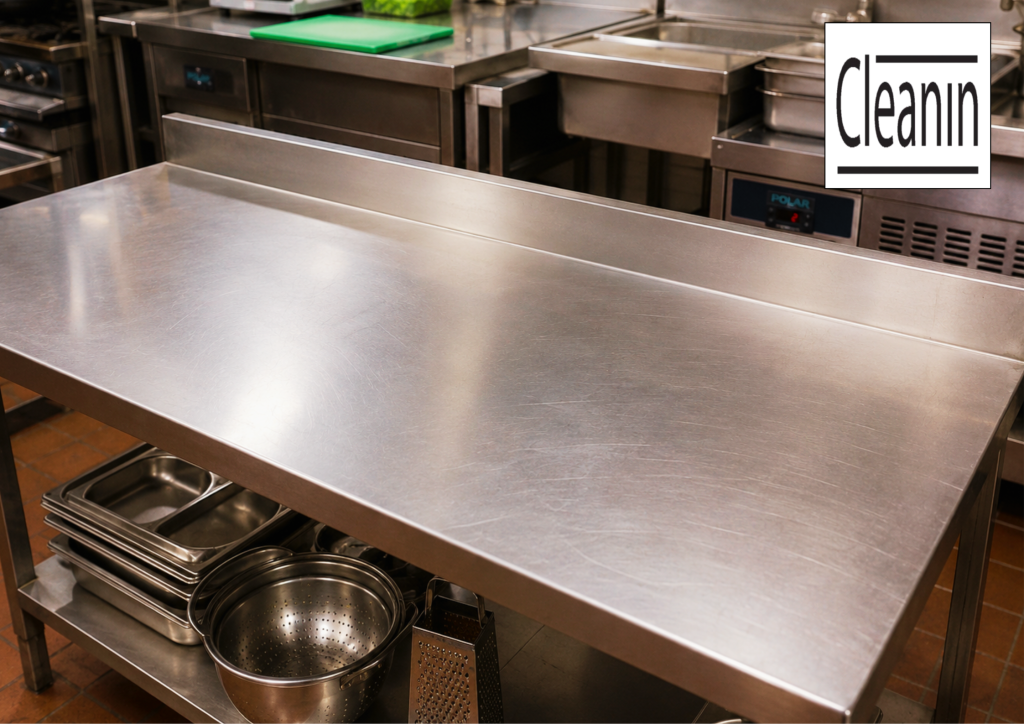
Commercial food preparation surfaces, including stainless steel benches, cutting boards, and food processor contact parts, require cleaning and sanitising after each use and at a minimum of twice daily during active service periods.
Commercial food preparation surfaces cleaning follows these 4 processes:
- Remove all food debris and surface soiling with a food-safe detergent and a clean cloth.
- Rinse with clean water to remove detergent residue.
- Apply food-safe sanitiser at the concentration verified by a sanitiser test strip immediately before application. Test strips confirm the sanitiser is within the effective concentration range. Over-diluted sanitiser does not reach the efficacy stated on the product SDS. Over-concentrated sanitiser leaves chemical residue that contaminates food.
- Allow the sanitiser to remain wet on the surface for the full dwell time specified on the SDS typically 30 seconds to 2 minutes, before wiping or allowing the surface to air dry.
Colour-coded microfibre systems are applied directly to food preparation surfaces. A minimum 3-colour system assigns separate cloth colours to raw protein zones, ready-to-eat zones, and general surface areas. Cross-zone cloth use transfers allergen residue and raw protein contamination between surfaces even when the cloth appears clean.
Cutting boards require separate protocols based on material. Polypropylene boards tolerate commercial dishwasher sanitising cycles at 82 degrees Celsius minimum. Wooden cutting boards absorb sanitiser and cannot be verified as clean by ATP testing.
Commercial Kitchen Floors and Drain Channels
Commercial kitchen floors require degreasing with a purpose-formulated floor degreaser after every service period. Standard mop water does not cut through the grease film that builds up near cooking equipment. Floor drain channels require daily flushing and hot-water treatment for fat and protein biofilm removal.
Standard cold-water mopping on a greasy kitchen floor distributes the grease film across a larger surface area rather than removing it. This is the primary cause of ongoing slip hazard conditions in commercial kitchens despite regular mopping. A degreasing floor cleaner applied at the correct dilution removes the grease emulsification from the floor surface. The floor must be rinsed after the degreasing step to remove the emulsified grease and chemical residue before it dries.
Floor drain channels accumulate fat, protein residue, and food particles that form biofilm on channel walls over time. Hot-water pressure washing at 80 to 155 degrees Celsius is the only method that dissolves established fat and protein biofilm in drain channels. Cold-water flushing and enzymatic drain treatments address ongoing organic accumulation but cannot remove established biofilm without the heat component.
The daily floor drain cleaning follows these 3 processes:
- Flush the drain channel with hot water from a kettle or hot-water tap to clear surface accumulation.
- Apply enzymatic drain treatment to drain channels at the end of the last service period each day. Enzymatic treatment works overnight through biological digestion and is flushed clear before service begins the following morning.
- Remove and clean drain cover grates in a separate bucket of degreaser solution. Drain covers accumulate grease on the underside, where visual inspection misses the buildup.
Commercial Kitchen Grease Trap
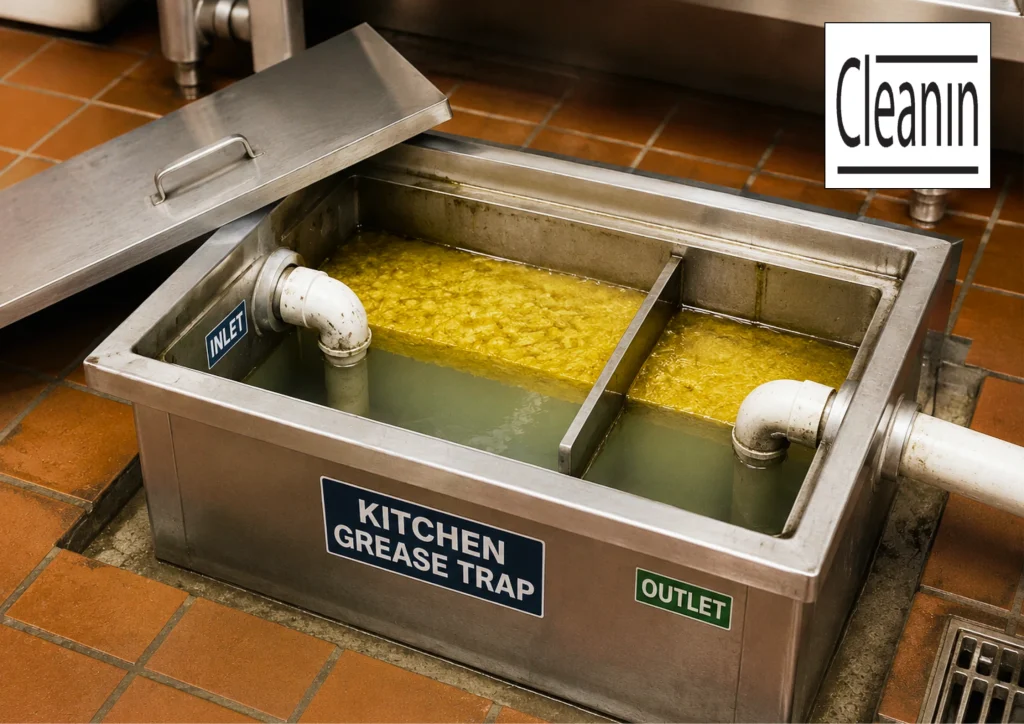
A commercial kitchen grease trap requires cleaning when accumulated fats, oils, and grease (FOG) reach 25% of the trap’s total capacity. This is the one-quarter rule, a capacity-based trigger, not a calendar-based schedule. High-volume commercial kitchens typically reach this threshold every 1 to 3 months. Low-volume kitchens reach it every 3 to 6 months.
Relying on a fixed monthly or quarterly calendar creates two operational risks. Kitchens cleaning below the 25% threshold waste service cost without any hygiene benefit. Kitchens that exceed the threshold before their scheduled clean allow FOG to bypass the trap and enter the sewer line, creating a blockage risk and a trade waste compliance breach with the local water authority.
Signs a grease trap requires cleaning before the next scheduled service:
- Slow drainage in kitchen sinks or floor drains.
- Foul odours from drain lines or under-bench areas.
- Visible grease layer on the water surface when the trap lid is inspected.
- Grease backs up into sinks or floor drains during peak service.
The grease trap requires these 9 cleaning processes (under-sink trap)
- Shut off water flow to the trap and allow the contents to cool.
- Remove the lid carefully and set it aside on a stable surface.
- Insert a measuring stick to record the FOG layer depth before removal. This measurement is the compliance record for council trade waste documentation.
- Remove FOG and solid waste using a pump or a manual scoop into sealed containers for licensed disposal. FOG waste must not be poured into any drain or bin.
- Scrape the trap interior walls, lid, and baffles with a long-handled brush to remove caked grease deposits.
- Apply enzymatic degreaser to interior surfaces, dwell for the time on the product SDS, and scrub with a stiff brush.
- Rinse the trap interior with clean water.
- Restore the water level in the trap before replacing the lid. The water level creates the hydraulic seal that prevents sewer gases from entering the kitchen.
- Record the date, FOG depth measurement, waste volume, and disposal method in the grease trap maintenance log.
Large grease interceptors installed externally require a licensed pump-out contractor. These are not suitable for in-house cleaning due to tank size and waste volume.
How Often Should Commercial Kitchen Equipment Be Cleaned?
There is no single cleaning schedule that works for every commercial kitchen. The ideal cleaning frequency depends on equipment usage, the type of food prepared, and the volume of grease, heat, and food residue generated.
As a general rule, equipment that comes into direct contact with food or produces large amounts of grease must be cleaned daily. Regular cleaning improves hygiene, extends equipment lifespan, reduces fire risks, and ensures compliance with food safety standards.
Daily Cleaning
High-use cooking and preparation equipment must be cleaned daily to prevent grease buildup, reduce bacterial growth, and prepare the kitchen for the next service.
- Fryers: Drained, filtered, and wiped down.
- Grills and cooktops: Scraped, degreased, and wiped.
- Stainless steel preparation benches: Sanitised throughout the day and at the end of service.
- Sinks and wash areas: Scrubbed and sanitised.
- Dishwashers: Drained, filters cleared, and rinsed.
- Kitchen floors: Swept, mopped with commercial degreaser, and squeegeed.
Weekly Cleaning
Equipment that does not require daily teardowns still accumulates moisture, spills, and carbonized food particles over seven days.
- Commercial Ovens: Internal racks removed, walls scrubbed, and baked-on carbon removed.
- Refrigerators and freezers: Door seals wiped, handles sanitised, and interior spills cleared.
- Shelving units and dry storage: Wiped down to prevent dust and mould growth.
Monthly Cleaning
Equipment exposed to grease-laden vapours requires targeted monthly maintenance to prevent airflow restriction and fire hazards.
- Range hoods and canopy filters: Filters should be removed, soaked in a grease-dissolving solution, and pressure washed.
- Deep freezers: Defrosted (if required) and thoroughly sanitised.
Periodic Deep Cleaning for Exhaust Systems (AS 1851 Compliance)
Kitchen exhaust systems including the internal canopy, exhaust fan, and hidden ductwork continuously collect highly flammable grease.
- Frequency: Ranges from monthly to annual, depending on cooking volume and fuel type (e.g., solid-fuel cooking, such as charcoal, requires monthly cleaning). Most standard commercial kitchens require professional servicing every 3 to 6 months.
- Compliance: This specialized deep cleaning must be performed by a professional commercial cleaning service to ensure compliance with Australian Standard AS 1851, which mandates regular fire safety maintenance of mechanical ventilation.
What Chemicals are used to Clean Commercial Kitchen Equipment?
Commercial kitchen equipment is exposed to grease, oil, food residue, carbon deposits, and bacteria every day. To remove these contaminants safely and effectively, different types of cleaning chemicals are used depending on the equipment, surface material, and level of contamination.
Some of the chemicals used to clean commercial kitchen equipment are:
- Food-Safe Degreasers
- Sanitisers
- Oven and Grill Cleaners
- Neutral and Multi-Purpose Cleaners
- Glass and Stainless Steel Cleaners
- Descaling Chemicals
1. Food-Safe Degreasers
Food-safe degreasers break down grease, oil, and food residue on ovens, grills, cooktops, fryers, and stainless steel surfaces. They are formulated to be effective without leaving harmful residues when used at the correct dilution. Specialised range cleaners fall within this category, formulated specifically for burnt-on grease and carbon deposits on cooking ranges.
2. Sanitisers
Sanitisers are applied after cleaning to reduce harmful microorganisms to safe levels. They do not remove grease or dirt.
In commercial kitchens, cleaning and sanitising are separate but equally important steps. Surfaces should always be cleaned before sanitiser is applied to ensure maximum effectiveness.
3. Oven and Grill Cleaners
Oven and grill cleaners are formulated for baked-on grease and carbon deposits that standard products cannot remove. They are used during deep cleaning cycles and require careful application, thorough rinsing, and adequate ventilation.
4. Neutral and Multi-Purpose Cleaners
Neutral and multi-purpose cleaners handle routine cleaning of surfaces that do not need aggressive chemicals. They are suitable for stainless steel benches, splashbacks, external equipment surfaces, and food preparation areas. They remove light dirt and spills without damaging delicate finishes.
5. Glass and Stainless Steel Cleaners
Glass and stainless steel cleaners remove fingerprints, smudges, and light grease while preserving the protective finish of the metal or glass. Using the correct product prevents scratching, streaking, and corrosion.
6. Descaling Chemicals
Descalers dissolve mineral deposits in commercial dishwashers, steamers, kettles, and coffee machines caused by hard water. Regular descaling maintains equipment efficiency and extends the lifespan of heating elements and water circulation systems.
To know more about cleaning chemicals, check out the blog on commercial cleaning agents.
What are the Common Mistakes When Cleaning Commercial Kitchen Equipment?
Cleaning commercial kitchen equipment is about more than wiping down visible surfaces. Done poorly, it can leave food safety risks in place, wear out equipment faster, and create problems that are expensive to fix.
These are the mistakes that come up most often when cleaning commercial kitchen equipment:
1. Using the wrong chemicals
Harsh or incompatible cleaners damage surfaces and leave residues that don’t belong near food. Strong abrasives scratch stainless steel. Products not rated for food environments can leave harmful traces behind. The chemicals need to match both the equipment and the type of contamination.
2. Skipping sanitising
Cleaning and sanitising are two separate steps. Cleaning removes grease, dirt, and food residue. Sanitising reduces bacteria on the surface. A kitchen that gets cleaned but not sanitised can look spotless and still have a contamination problem.
3. Missing hard-to-reach areas
Grease and food particles build up in places nobody looks: under cooking equipment, behind refrigerators, around seals and hinges, inside range hood filters, and inside exhaust ducts. These spots don’t clean themselves, and ignoring them long enough turns a hygiene issue into a safety one.
4. Overlooking the exhaust system
Exhaust hoods, canopy filters, fans, and ductwork collect grease-laden vapour every time the kitchen runs. The buildup reduces airflow and raises fire risk. Because most of it is hidden inside the system, this isn’t a job that gets done with a cloth and a spray bottle.
5. Cleaning too infrequently
By the time grease or residue is visible, it’s already been building up for a while. In a commercial kitchen running full shifts, that happens fast. Infrequent cleaning means reduced equipment efficiency, higher maintenance costs, more fire risk, bacterial growth, and shorter equipment lifespan.
6. Using too much water near electrical components
Some equipment has electrical parts that corrode or malfunction when they get wet. Spraying liquids onto control panels, wiring, or heating elements is a real hazard. Manufacturer guidelines exist for a reason.
7. Skipping professional deep cleaning
Day-to-day cleaning can be handled in-house. Deep cleaning of ovens, fryers, and exhaust systems is a different matter. Without the right training, equipment, and chemicals, the job either doesn’t get done properly or causes damage. Most commercial kitchens in Greater Sydney that run a tight operation bring in a professional cleaning service for scheduled deep cleans and exhaust work.
Professional Commercial Kitchen Cleaning Services in Greater Sydney
Commercial kitchen cleaning goes beyond surface appearance. It requires the right chemicals, structured processes, and a working knowledge of food safety requirements for each equipment type.
Cleanin provides professional commercial kitchen cleaning services across Greater Sydney including ovens, fryers, grills, refrigeration units, stainless steel surfaces, and complete kitchen exhaust systems including canopies, filters, fans, and ductwork.
Our team uses food-safe chemicals, eco-friendly products, and industrial-grade equipment to deliver consistent results. We offer both scheduled cleaning programs and one-time deep cleaning services.
Contact Cleanin to request a commercial kitchen cleaning quote for your Greater Sydney operation.