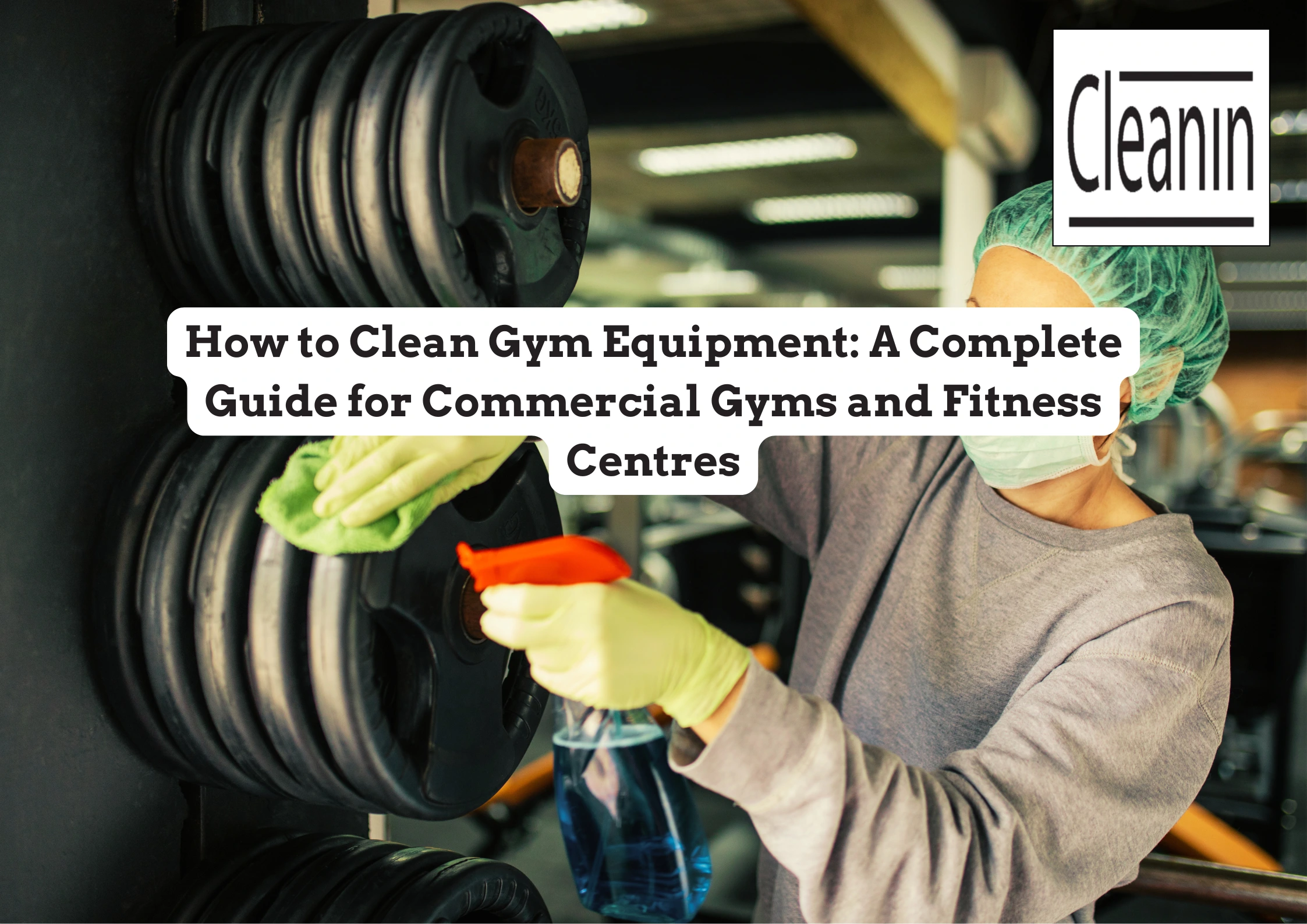
Cleaning gym equipment is not just about making machines look presentable. It is a critical part of maintaining hygiene standards, protecting member health, and extending the lifespan of cardio machines, strength equipment, free weights, and flooring.
Cardio machines, strength equipment, free weights, and touchpoints are exposed to sweat, skin oils, dust, and frequent contact every day. Without proper cleaning and disinfection, these surfaces can spread germs and cause unnecessary wear and tear on costly fitness equipment.
The cleaning process goes beyond wiping visible sweat. Commercial gyms and fitness centres should follow equipment-specific cleaning procedures, use safe disinfectants, and maintain a structured cleaning schedule to ensure consistent hygiene across the facility.
This guide explains how to clean gym equipment properly, what gym equipment cleaning involves, how often equipment should be cleaned, and what a professional cleaning program delivers beyond what in-house staff can realistically maintain.
How to Clean Gym Equipment Properly?
Cleaning gym equipment properly involves more than removing visible sweat after workouts. Every treadmill, exercise bike, dumbbell, and strength machine accumulates body oils, dust, bacteria, and moisture throughout the day. If these contaminants are not removed correctly, they can affect hygiene standards, reduce equipment lifespan, and create an unpleasant experience for gym members.
The most effective gym cleaning programs follow a process:
Inspect → Clean → Disinfect → Allow Contact Time → Dry
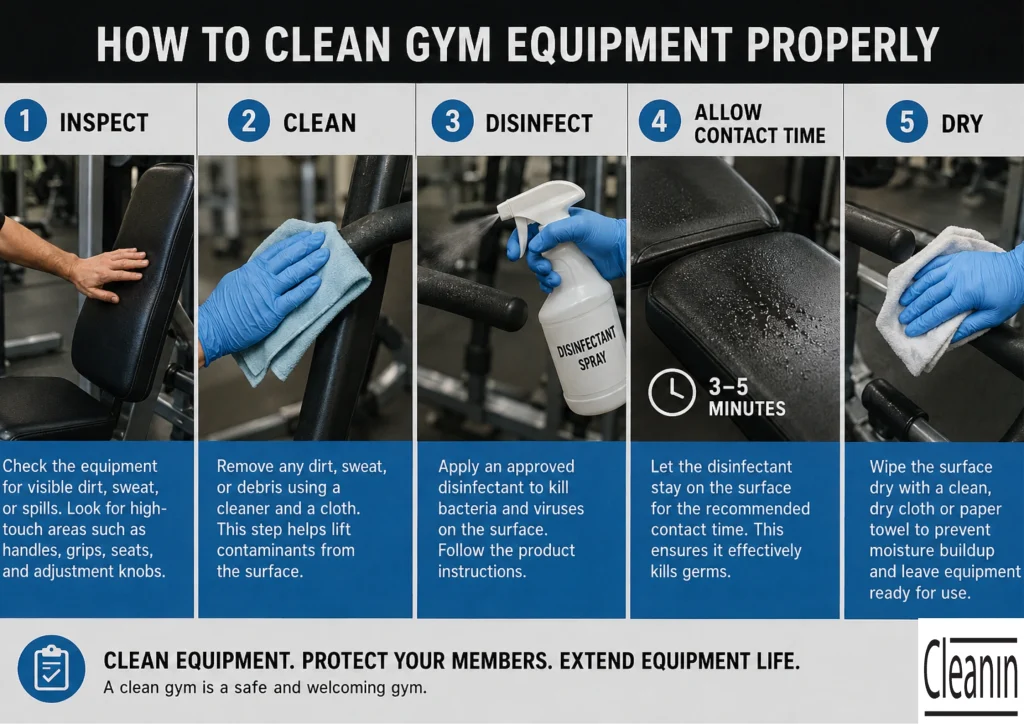
Each stage serves a specific purpose. Skipping one step can reduce the effectiveness of the entire cleaning process.
These are the 8 steps to clean gym equipment in commercial cleaning services:
- Step 1: Start by Inspecting the Equipment
- Step 2: Remove Dust, Sweat, and Surface Dirt
- Step 3: Choose Cleaning Products That Are Safe for Gym Equipment
- Step 4: Focus on High-Touch Areas First
- Step 5: Disinfect the Equipment Correctly
- Step 6: Allow Enough Contact Time
- Step 7: Dry the Equipment Thoroughly
- Step 8. Establish a Consistent Cleaning Routine
Step 1: Start by Inspecting the Equipment
Before using any cleaning chemical, inspect the equipment carefully. Commercial gyms contain different equipment materials, including rubber, vinyl, steel, plastic, and electronic touchscreens. Each material responds differently to moisture and cleaning products. A chemical that works well on a rubber dumbbell may damage a treadmill console or vinyl seat.
During inspection, look for signs of heavy use such as dried sweat, chalk residue, dust accumulation, or sticky surfaces. Also check for damaged upholstery, rust spots, loose handles, and cracked screens.
This initial inspection helps determine which areas require more attention and prevents existing damage from becoming worse during cleaning.
More importantly, it helps identify high-touch surfaces. These are the areas most likely to harbour germs because they are touched repeatedly by different gym users throughout the day.
Step 2: Remove Dust, Sweat, and Surface Dirt
The next step is cleaning the gym equipment. Many people confuse cleaning with disinfecting, but they are not the same thing. Cleaning removes visible contaminants such as dirt, sweat, oils, and dust. Disinfecting kills microorganisms that remain on the surface after cleaning.
If sweat and dirt remain on equipment, disinfectants become less effective. This is why cleaning should always come before disinfection.
Begin by wiping down all exposed surfaces using a microfibre cloth and an equipment-safe cleaner. Microfibre cloths are preferred because they trap dirt particles instead of spreading them around the surface.
Pay particular attention to areas where sweat accumulates regularly. Handles, handrails, seats, backrests, and grips often contain a mixture of sweat, skin oils, and dust that builds up gradually over time.
Cardio equipment requires additional attention. Dust commonly accumulates underneath treadmills, around exercise bikes, and inside ventilation openings. If left untreated, this dust can enter motors and moving components, affecting performance and increasing maintenance costs.
Cleaning these areas regularly not only improves hygiene but also protects the equipment from premature wear.
Step 3: Choose Cleaning Products That Are Safe for Gym Equipment
Not all cleaning chemicals are suitable for gym equipment. Commercial gym equipment contains a combination of sensitive materials. Rubber coatings can crack when exposed to harsh chemicals. Vinyl upholstery can fade or become brittle. Electronic touchscreens and control panels are especially vulnerable to moisture and abrasive cleaners.
A safe cleaning product should effectively remove dirt while protecting the material underneath.
Neutral pH cleaners and eco-friendly cleaning chemicals are generally preferred because they clean effectively without damaging equipment surfaces. For disinfection, many commercial gyms use TGA-approved disinfectants that are proven effective against common bacteria and viruses while remaining safe for regular use.
Products containing bleach, ammonia, or abrasive ingredients should be avoided unless specifically approved by the equipment manufacturer.
Over time, repeated use of harsh chemicals can shorten the lifespan of expensive gym equipment and increase replacement costs.
Step 4: Focus on High-Touch Areas First
Not every surface in a gym carries the same contamination risk. Some areas are touched hundreds of times every day, making them more likely to accumulate bacteria, viruses, and sweat residue.
Handles on treadmills, resistance adjustment knobs on exercise bikes, selector pins on weight machines, dumbbell grips, and touchscreens are among the highest-risk areas.
Interestingly, some of the most contaminated surfaces are also the most overlooked.
Selector pins on strength machines are a good example. Gym members touch them constantly while adjusting weights, yet they are often ignored during routine cleaning. The same applies to adjustment levers, seat controls, and textured grips on barbells.
Cleaning staff should prioritise these high-touch areas throughout the day rather than focusing only on large visible surfaces.
Step 5: Disinfect the Equipment Correctly
Once dirt and sweat have been removed, the next step is disinfection. Disinfecting reduces the number of harmful microorganisms that remain on equipment surfaces. This step is especially important in commercial gyms where equipment is shared among many members throughout the day.
However, proper disinfection is not simply spraying chemicals and wiping immediately. The disinfectant must be compatible with the equipment material and applied correctly.
Never spray disinfectant directly onto touchscreens, LCDs, charging ports, or electronic control panels. Excess moisture can seep into internal components and cause permanent damage.
Instead, apply the disinfectant to a cloth first and wipe the surface gently. For rubber dumbbells, barbells, and metal equipment, ensure the disinfectant reaches textured areas and knurled grips where sweat and dirt often become trapped.
Professional gym cleaning services usually use colour-coded microfiber systems during this stage. Different coloured cloths are assigned to different cleaning zones to reduce the risk of cross-contamination.
This approach prevents bacteria from spreading from floors to equipment or from one area of the gym to another.
Step 6: Allow Enough Contact Time
One of the biggest mistakes gyms make is wiping disinfectants away too quickly. Every disinfectant requires a specific amount of time to kill microorganisms effectively. This period is known as the contact time.
Some products require surfaces to remain wet for thirty seconds. Others may need several minutes. If the surface is dried immediately after application, the disinfectant may not achieve its intended level of protection.
Allowing sufficient contact time is particularly important during cold and flu season or periods of increased infection risk when hygiene standards become even more critical. This small step often separates basic cleaning from professional cleaning.
The chemical itself is important, but the cleaning technique determines how effective it becomes.
Step 7: Dry the Equipment Thoroughly
After disinfection, the equipment should be dried completely. Moisture left on surfaces can create a range of problems. Metal components begin to rust. Upholstery can deteriorate faster. Rubber surfaces can become slippery, and moisture around electronic systems may increase the risk of malfunction.
Drying also improves the user experience. Gym members are unlikely to use equipment that feels wet or sticky.
Use clean microfibre cloths to remove excess moisture from seats, handles, touchscreens, and grips. Pay extra attention to textured metal surfaces because water can become trapped in grooves and accelerate corrosion over time.
This step may seem simple, but it has a significant impact on both equipment longevity and member satisfaction.
Step 8. Establish a Consistent Cleaning Routine
Even the best cleaning method is ineffective if it is not performed consistently. Gym equipment is exposed to contamination every day. Sweat, dust, and germs begin accumulating almost immediately after cleaning.
For this reason, commercial gyms rely on structured cleaning schedules rather than occasional cleaning sessions.
High-touch surfaces may require cleaning after each use. Cardio and strength equipment are generally cleaned daily. Areas beneath equipment, storage racks, and hard-to-reach spaces should be cleaned weekly, while deep cleaning and detailed sanitation are performed monthly or quarterly.
A regular cleaning schedule creates consistency. It helps maintain hygiene standards, protects expensive equipment, and gives gym members confidence that the facility takes cleanliness seriously.
For this reason, commercial gyms rely on structured cleaning schedules rather than occasional cleaning sessions. Many facilities use a comprehensive Gym Cleaning Checklist to ensure equipment, floors, amenities, and high-touch surfaces are cleaned consistently according to daily, weekly, and monthly requirements.
What Cleaning Products Are Safe to Use on Gym Equipment?
In commercial gyms and fitness centres, cleaning chemicals not only affect cleanliness but also directly impact equipment safety, material durability, and compliance with hygiene standards.
A Commercial Cleaning Service does not treat all cleaning products as interchangeable. Instead, it selects chemicals based on equipment material, contamination level, and hygiene requirements. This is what separates basic cleaning from professional-grade facility maintenance.
Gym equipment contains a mix of sensitive materials such as rubber, vinyl, coated steel, plastic, foam padding, and electronic components. Each material reacts differently to moisture, pH levels, and chemical strength. Using the wrong product can shorten equipment lifespan, damage surfaces, or reduce hygiene effectiveness.
The cleaning products that are safe to use on gym equipment are:
- Neutral pH Cleaners
- TGA-Approved Disinfectants
- Alcohol-Based Solutions
- GECA-Certified Eco-Friendly Cleaners
- Enzymatic Cleaners
1. Neutral pH Cleaners
Neutral pH cleaners are the most commonly used base cleaning solution in commercial gym environments. Neutral pH cleaners are used to remove everyday contaminants from gym equipment such as sweat, body oils, dust, and light grime without affecting surface integrity.
These cleaners are suitable for:
- Rubber-coated dumbbells and kettlebells
- Vinyl upholstery on benches and machines
- Powder-coated steel frames
- Plastic covers and housing components
In commercial cleaning services, Neutral pH Cleaners are typically used as the first step in the cleaning phase before disinfection begins.
2. TGA-Approved Disinfectants (For Infection Control and Hygiene Compliance)
Disinfection plays a separate role from cleaning. While cleaning removes visible dirt, disinfectants are used to reduce microorganisms such as bacteria, viruses, and fungi.
In professional gym cleaning environments, TGA-approved disinfectants are commonly used because they meet Australian regulatory standards for safety and effectiveness.
These products are suitable for:
- Treadmill handrails and control panels
- Exercise bike handles and seats
- Strength machine grips and adjustment points
- High-touch shared equipment surfaces
However, disinfectants must always be used correctly. They should be applied only after surfaces are cleaned, because organic matter like sweat or dust can reduce their effectiveness.
Proper application also requires respecting contact time, which is the period the surface must remain wet for the disinfectant to work effectively.
3. Alcohol-Based Solutions (For Fast-Drying High-Touch Area)
Alcohol-based cleaning solutions are often used in commercial gyms for quick disinfection of high-touch points.
They are effective in fast-paced environments because they evaporate quickly, leave minimal residue, and work well on frequently touched surfaces.
Alcohol-Based Solutions are commonly used on:
- Touchscreens and display panels
- Cardio machine buttons
- Hand-held equipment surfaces
- Lightly soiled grips and handles
4. GECA-Certified Eco-Friendly Cleaners (Sustainable Commercial Cleaning Choice)
Modern commercial cleaning services are increasingly using GECA-certified cleaning products to align with environmental and sustainability standards.
GECA-Certified Eco-Friendly Cleaners are suitable for:
- General gym surfaces
- Floors and mats
- Equipment frames
- Shared training areas
Eco-friendly cleaners are particularly useful in high-traffic fitness centres where cleaning occurs multiple times a day. They help maintain indoor air quality while reducing exposure to harsh chemical residues.
From a commercial cleaning perspective, these products also support sustainability commitments without compromising hygiene outcomes.
5. Enzymatic Cleaners (For Deep Contamination and Odour Control)
Enzymatic cleaners are specialized products used in situations where organic build-up is more severe.
Enzymatic Cleaners work by breaking down organic matter such as sweat residue, body oils, protein-based contaminants and odour-causing bacteria.
These cleaners are particularly useful for:
- Gym mats and functional training areas
- Upholstered benches and padding
- High-traffic flooring zones
- Equipment with persistent odour issues
Unlike standard cleaners, enzymatic solutions continue working after application, breaking down residues at a molecular level. This makes them effective for deep cleaning scenarios in commercial gym environments.
What Cleaning Products Should Be Avoided in Gym Equipment?
The chemical products that should be avoided in Gym Cleaning are:
- Harsh disinfectants such as bleach or ammonia-based products, which can corrode metal components and damage rubber surfaces over time. Abrasive cleaners and powders should also be avoided because they can scratch coatings and reduce equipment durability.
- Strong acidic or alkaline solutions may clean aggressively in the short term but often degrade vinyl upholstery, plastic housings, and electronic surfaces with repeated use.
- Steam cleaning is also not suitable for most gym equipment, especially electronic machines, due to moisture intrusion risks.
How often Should Gym Equipment be cleaned in a Commercial facility?
Commercial gym equipment should be cleaned according to a 3-tier schedule
- high-contact surfaces (barbell grips, cable handles, treadmill handrails, bench surfaces) disinfected a minimum of 3 times daily during peak hours.
- wet areas (showers, change rooms, sauna surrounds) disinfected twice daily.
- low-contact surfaces (mirrors, wall fixtures, reception) cleaned once daily.
Daily (every operational day)
- Wipe and disinfect all cardio machine contact surfaces (minimum 3 times during operating hours)
- Wipe and disinfect free-weight surfaces, bench pads, and cable handles
- Clean and disinfect wet areas twice (morning open and afternoon peak minimum)
- Mop and disinfect rubber and hardwood floor zones
- Empty bins and restock wipe-down stations, soap dispensers, and paper towels
- Disinfect high-touch points: door handles, locker handles, water fountain buttons, keypad entry
Weekly
- Deep clean cardio machines: remove detachable parts, brush knurled grips, lubricate belts and rollers
- Clean grout lines in shower and sauna tiles
- Dust and wipe air duct vents and HVAC return grilles
- HEPA vacuum rubber flooring before wet mopping
Monthly
- Inspect and test all mechanical equipment for wear
- Clean ceiling fixtures, light fittings, and high-level surfaces
- Deep clean locker interiors
- Window and exterior glass clean
Member-operated wipe-down stations are part of most commercial gym hygiene programs. Research indicates member compliance with between-use wiping ranges from 30 to 60 percent depending on station visibility and gym culture. A commercial cleaning schedule must achieve the required hygiene standard independently of member participation rather than relying on it alone.
What are the Common Mistakes to Avoid When Cleaning Gym Equipment?
Some of the common mistakes to avoid when cleaning gym equipment are:
- Using Harsh Chemicals on Sensitive Equipment
- Spraying Cleaning Products Directly onto Electronics
- Ignoring Contact Time for Disinfectants
- Overlooking High-Touch Hidden Areas
- Relying Only on Member Wipe-Downs
- Using Too Much Cleaning Liquid
- Not Cleaning Equipment in the Correct Order
- Ignoring regular cleaning frequency
1. Using Harsh Chemicals on Sensitive Equipment
Chemical products like bleach, ammonia-based cleaners, and abrasive solutions may seem effective, but they often damage gym equipment over time.
These chemicals can fade or crack rubber grips, damage vinyl upholstery, corrode metal frames, strip protective coatings, and harm plastic covers and housings.
Professional cleaning services avoid this issue by using neutral pH cleaners and equipment-safe disinfectants matched to each surface type.
2. Spraying Cleaning Products Directly onto Electronics
Another frequent mistake is spraying disinfectants or cleaning liquids directly onto electronic components. Electronic equipments
This includes:
- Treadmill consoles
- Touchscreens
- Control panels
- Cardio machine displays
- Charging ports or exposed electrical areas
Direct spraying into treadmil consoles, touchscreens, cardio machine displays, and charging ports increases the risk of liquid entering internal circuits, which can cause malfunction or permanent damage.
Cleaning solutions should always be applied to a microfibre cloth first, then used to wipe the surface. This method protects sensitive electronics while still ensuring proper disinfection.
3. Ignoring Contact Time for Disinfectants
Many gyms apply disinfectant and immediately wipe it off, assuming the cleaning is complete. Disinfectants require a specific amount of time to effectively kill bacteria and viruses. This is known as contact time.
If the disinfectant is removed too early, microorganisms can survive, surface hygiene can become ineffective, and infection control standards can be compromised.
Each disinfectant product has a recommended contact time, which can range from seconds to several minutes depending on formulation.
4. Overlooking High-Touch Hidden Areas
Gym cleaning often focuses on visible surfaces while ignoring smaller, high-contact components.
These overlooked areas include:
- Selector pins on strength machines
- Adjustment levers and knobs
- Undersides of benches
- Cable attachments and handles
- Dumbbell and barbell grips
- Cup holders and accessory trays
These parts are touched frequently by multiple users throughout the day and can accumulate sweat, oils, and bacteria quickly.
Because they are less visible, they are often missed during routine cleaning. However, from a hygiene perspective, they are among the most critical points in a gym.
Professional cleaning systems include these areas in every cleaning cycle to ensure complete coverage.
5. Relying Only on Member Wipe-Downs
Many gyms depend heavily on members to wipe equipment after use. While this helps reduce surface contamination, it is not sufficient as a standalone hygiene strategy.
Member wipe-downs are inconsistent and surface-level only. A structured Commercial Cleaning Service is required to maintain full facility hygiene. Professional cleaners follow defined cleaning schedules that cover all equipment zones, not just high-visibility areas.
6. Using Too Much Cleaning Liquid
More cleaning solution does not mean better cleaning.
Overuse of liquid can cause several issues, such as:
- Moisture damage to upholstery
- Slippery surfaces creating safety risks
- Liquid entering mechanical parts
- Longer drying times
- Increased risk of rust or corrosion
Excess liquid is especially problematic for cardio machines and electronic equipment.
The correct method is controlled application using a lightly damp microfibre cloth rather than direct saturation.
7. Not Cleaning Equipment in the Correct Order
Cleaning order plays an important role in hygiene effectiveness. A common mistake is disinfecting before cleaning or mixing both steps incorrectly.
When disinfectant is applied before removing dirt and sweat:
- Organic matter reduces disinfectant effectiveness
- Germs may survive beneath surface residue
- Cleaning becomes less efficient
8. Ignoring Regular Cleaning Frequency
Another major issue is inconsistent cleaning schedules. Some gyms clean only when equipment looks dirty, which leads to bacteria build-up over time, unpleasant odours, faster material degradation and reduced member satisfaction
How does a Commercial Cleaner Cleans Gym Equipment Differently From in-house Staff?
A commercial cleaner cleans gym equipment differently from in-house staff in the following ways:
Colour-coded microfibre
A professional gym cleaning program assigns separate microfibre colours to separate facility zones. A standard assignment: red for toilets and urinals, blue for general surfaces and equipment, green for café or protein bar areas, yellow for change room fixtures. Cross-zone use of a single cloth transfers pathogens between the building’s highest-risk surfaces.
ATP bioluminescence verification
ATP testing uses a luminometer to detect adenosine triphosphate (ATP), a substance found in all living organic matter, on surfaces after cleaning. The device measures contamination levels in Relative Light Units (RLU).
For example, on Hygiena luminometers:
- Below 50 RLU: Clean surface
- Above 100 RLU: Failed clean requiring recleaning
ATP testing provides objective, documented evidence of cleaning performance that visual inspections alone cannot provide.
HEPA filtration
Commercial gym cleaning uses HEPA H-Class Vacuums on rubber flooring and foam mat surfaces. HEPA H-Class filtration captures particles down to 0.3 microns at 99.97% efficiency, including the fine particulate from chalk dust (calcium carbonate) that is common in weightlifting zones.
By comparison, standard domestic vacuums may recirculate fine particles back into the air, reducing indoor air quality.
Staff Qualifications
Cleaning staff with a Certificate III in Cleaning Operations (CPP30316) receive training in:
- Infection control principles
- Safety Data Sheet (SDS) management
- Safe chemical handling procedures
This training is particularly important in gym environments where cleaning products come into contact with members, equipment surfaces, and electronic fitness machines.
Get Professional Gym Equipment Cleaning Services from Cleanin
Keeping gym equipment clean is not only about maintaining appearance. It directly affects hygiene, safety, and the overall member experience. In high-traffic fitness environments, equipment gets used continuously, which makes regular cleaning and disinfection essential rather than optional.
While basic wipe-down routines help with surface-level maintenance, they are often not enough for gyms where multiple users share equipment throughout the day. This is where a structured and professional approach becomes important.
Cleanin, as a professional Commercial Cleaning Service, provides specialised gym and fitness centre cleaning designed to maintain consistent hygiene standards across all equipment types. From treadmills and strength machines to free weights and mats, every surface is cleaned using proper methods that protect both users and equipment.
Looking to maintain a cleaner, safer gym environment?
If you manage a gym, fitness studio, hotel fitness area or corporate wellness space, Cleanin can help you set up a reliable cleaning system tailored to your facility. Our team can assess your site, understand your usage patterns, and deliver a customised commercial cleaning plan that keeps your equipment hygienic and well-maintained.
A commercial gym cleaning checklist only delivers results when it is applied consistently across every zone of the facility. Daily disinfection of equipment, weekly deep cleaning of floors and wet areas, and scheduled restorative maintenance all work together to control contamination, protect members, and extend the life of gym assets. For fitness centres, training studios, and sporting facilities that need reliable execution of these standards, professional sporting and fitness facility cleaning services provide the structured programs, specialist equipment and trained teams required to keep gyms clean, safe, and ready for every member.